

On this page
Sales orders, invoices and receipts
What happens when a confirmed sales order is fulfilled. The one sales invoice it makes in Tally and why no delivery note is made, what is left to receive and when it falls due, money received in part or in full, the customer's statement, what each line under In Tally means, and what to do when Tally refuses an invoice.
9 minute read
The short version
A sales order moves nothing until it is fulfilled. Fulfilling it makes one sales invoice in Tally, for every confirmed quantity, at the rates and the credit days agreed. That invoice is the one thing that moves the stock and posts to the accounts.
| What happens | What goes into Tally | When |
|---|---|---|
| An order is written, changed or confirmed | Nothing | |
| An order is fulfilled | One sales invoice, reference SO- and the order's number | When you press Fulfil and invoice |
| Money is received, in part or in full | A receipt against that invoice, for each amount | Once the invoice is in Tally |
| An order is cancelled | Nothing |
How an order stands is three things, said separately at the head of its page: the order, the money, and Tally. Fulfilled does not mean paid, and it does not mean in Tally.
Who this is for
| To do this | You need |
|---|---|
| Fulfil an order, record money received, press Send to Tally again | Fulfil sales orders and record what is received |
| See how an order stands in Tally | Write and confirm sales orders, or See bills and entries |
| See what the customer owes on the order's page | Write and confirm sales orders, or See figures and reports |
| Open Their statement | See figures and reports |
| The view Waiting for Tally | See bills and entries |
| Try again or Discard on a refused invoice | Make bills and record payments |
So a Dispatcher fulfils orders and records what is received. The Order desk writes and confirms them, and sees how each stands. The owner or the accountant looks after anything Tally refuses. See Users and roles.
Sales orders are a pilot, open to a few businesses while they are being tried. Writing and confirming an order are in Write a sales order.
Fulfil, when the goods go
Fulfil an order when its goods go. It has to be confirmed.
- Open the order. Check What will be sent: the confirmed quantity of each line is what goes on the invoice.
- If something cannot go, lower its confirmed quantity and press Save the confirmed quantities first.
- Press Fulfil and invoice, with the amount, at the head of the page.
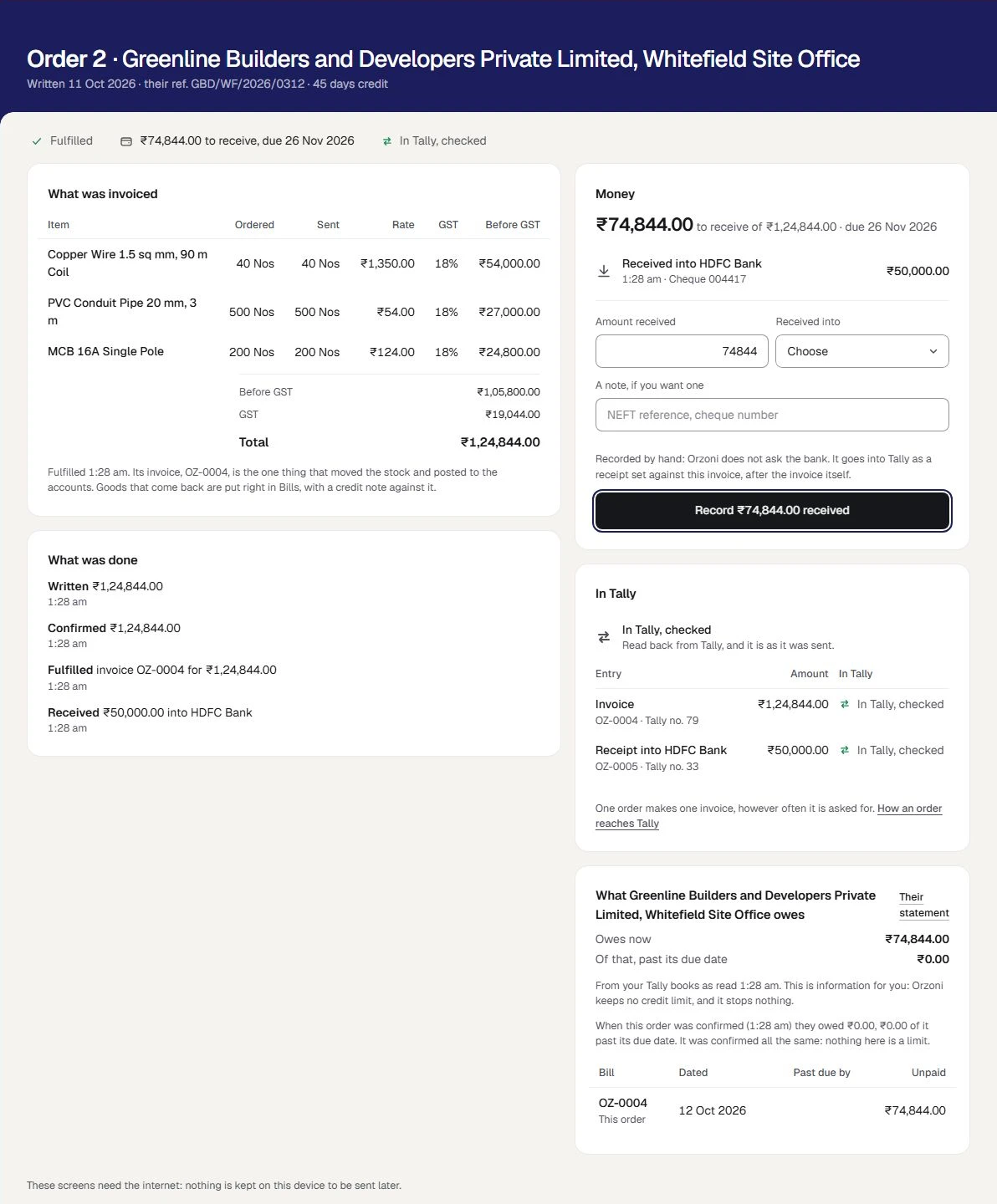
A small message says Fulfilled. Its invoice goes into Tally by itself. The order reads Fulfilled, the card becomes What was invoiced, with Ordered and Sent side by side, and Money says what there is to receive and when it falls due.
An order is fulfilled whole, and once. Every confirmed quantity goes on the one invoice. There are no part deliveries and no back orders. What cannot be sent is taken off the confirmed quantity before fulfilling, and ordered again when the goods are in.
Pressed twice, sent again, or tried again after a break in the connection, it is still one invoice.
The one invoice
It is made by the same part of Orzoni that makes every other bill.
| On the invoice | Where it comes from |
|---|---|
| The customer | The customer the order was written for |
| The date | The day the order was fulfilled |
| Each item | A line for the stock item, with its confirmed quantity and the rate agreed. It leaves Tally's stock, as on any sales bill |
| GST | Worked out for the customer's own state: CGST and SGST for one in your state, IGST for one in another |
| Credit days | The ones agreed on the order |
| The reference | SO- and the order's number, such as SO-7 |
| The total | To the paisa. An order does not round its invoice to the rupee |
From then on it is a bill like any other. It is under Sales, Invoices and in the Day book, and it is in every figure: sales, what the customer owes, GST and stock.
If the part that makes bills refuses the invoice, the order is not fulfilled, and the screen says why in that part's own words. Nothing is made.
Why no delivery note is made
No delivery note, and no sales order in Tally, is made. The invoice is the one entry.
That is on purpose. A delivery note would be a second entry for the same goods, to be kept in step with the invoice. With the invoice as the one event, the goods leave stock once, by the entry that also posts the sale. A delivery note you need on paper is made in Tally.
What is left to receive, and when
On a fulfilled order, the card Money leads with what is left: an amount to receive of the invoice's total, and the day it falls due. The due date is the invoice's date and the credit days agreed.
Once that day has passed and something is still to receive, the order reads Past its due date, at its head and on its row of the list.
To be paid, in the list, holds every fulfilled order with something left to receive, the oldest first.
Record money received
- On the fulfilled order, in the card Money, check Amount received. It starts as everything left, and can be less.
- Under Received into, choose the cash or bank account the money went into.
- Add a note if you want one, such as an NEFT reference or a cheque number.
- Press the button. It says what it will do, such as Record ₹5,000.00 received into HDFC Bank.
A small message says Recorded. It goes into Tally as a receipt against this invoice. The card shows what is still to receive. Record the rest the same way when it arrives. When nothing is left, the order reads Paid, and the card reads Paid in full.
- Part or all, never more. An amount cannot be more than is left on this invoice. Anything more is recorded under Payments received, on account.
- Recorded by hand. Orzoni does not ask a bank whether the money arrived. Look at your bank, or the cheque in your hand, first.
- Pressing twice records one receipt, not two.
- Money before the invoice. Until an order is fulfilled there is no invoice to receive against. Money taken before then is recorded under Payments received.
In Tally, each amount is a receipt, into the account you chose, set against that one invoice. It is sent only once the invoice is in Tally: until then it reads Waiting for Tally, behind its invoice.
The customer's statement
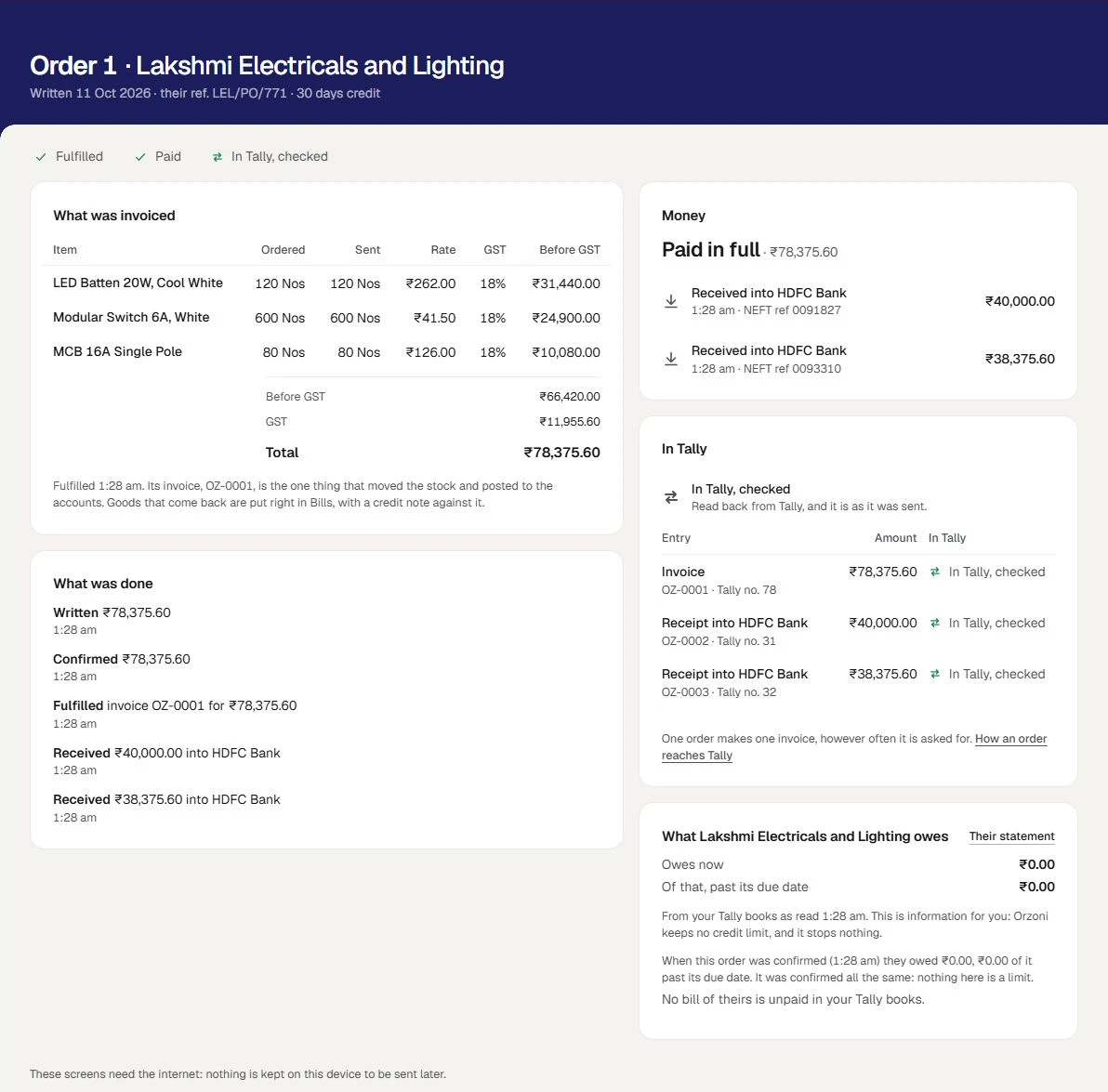
The statement is trading's own. It is the customer's page, the same for every account, and it holds every bill and receipt of theirs, this order's among them.
On an order's page, the card What the customer owes has:
- Owes now, and how much of it is past its due date. This is information: Orzoni keeps no credit limit, and it stops nothing.
- What they owed when this order was confirmed.
- Their oldest unpaid bills, up to twelve, with how far each is past due. This order's invoice is marked This order.
- Their statement, for whoever holds See figures and reports.
What In Tally says
On a fulfilled order, the card In Tally has one line for the order as a whole, then a table with a row for the Invoice and one for each receipt. Each row says for itself how it stands.
| The words | What they mean | What to do |
|---|---|---|
| Nothing yet, and no stock has moved. Its one invoice is made when the order is fulfilled. | The order is a draft, or confirmed | Nothing |
| Waiting for Tally | The entry is made, and goes into Tally by itself as soon as the computer that runs Tally can be reached | Nothing |
| In Tally, not checked yet | Tally has taken it. It is checked against Tally at the next read | Nothing |
| In Tally, checked | Read back from Tally, and it is as it was sent | Nothing. It is done |
| Refused by Tally | Tally would not take it. Tally's own reason is under it | See When Tally refuses the invoice |
| Not in Tally yet | No entry could be made yet. The reason is under it | Put the reason right. If it stays, write to us from Settings, Help and support |
| Not in Tally | The invoice was discarded before it reached Tally | See When the invoice was discarded |
| Changed in Tally | The entry was changed in Tally after it was sent | See Changed, or removed, in Tally |
| Check in Tally | Tally holds the entry, but not as it was sent | The same |
| Removed in Tally | The entry was cancelled or deleted in Tally afterwards | The same |
The same words stand on each row of Sales orders, on a line of their own under the order and the money. An order with an entry that needs someone is under Needs attention.
When Tally or its computer is off
Carry on. Orders are written, confirmed and fulfilled, and money is recorded, all as usual.
Each invoice and receipt reads Waiting for Tally. When the computer is on again with Tally open on your company, they go in by themselves, in the order they were made, each receipt after its invoice, and each is read back and checked. Nothing has to be sent again by hand.
The device you work on is a different thing: it needs the internet for every step. With no connection the screens say so, and nothing is kept on the device to be sent later.
When Tally refuses the invoice
Tally can say no for its own reasons: a date outside the period your company allows, or a ledger that was renamed. The order stays fulfilled. Only its invoice needs someone.
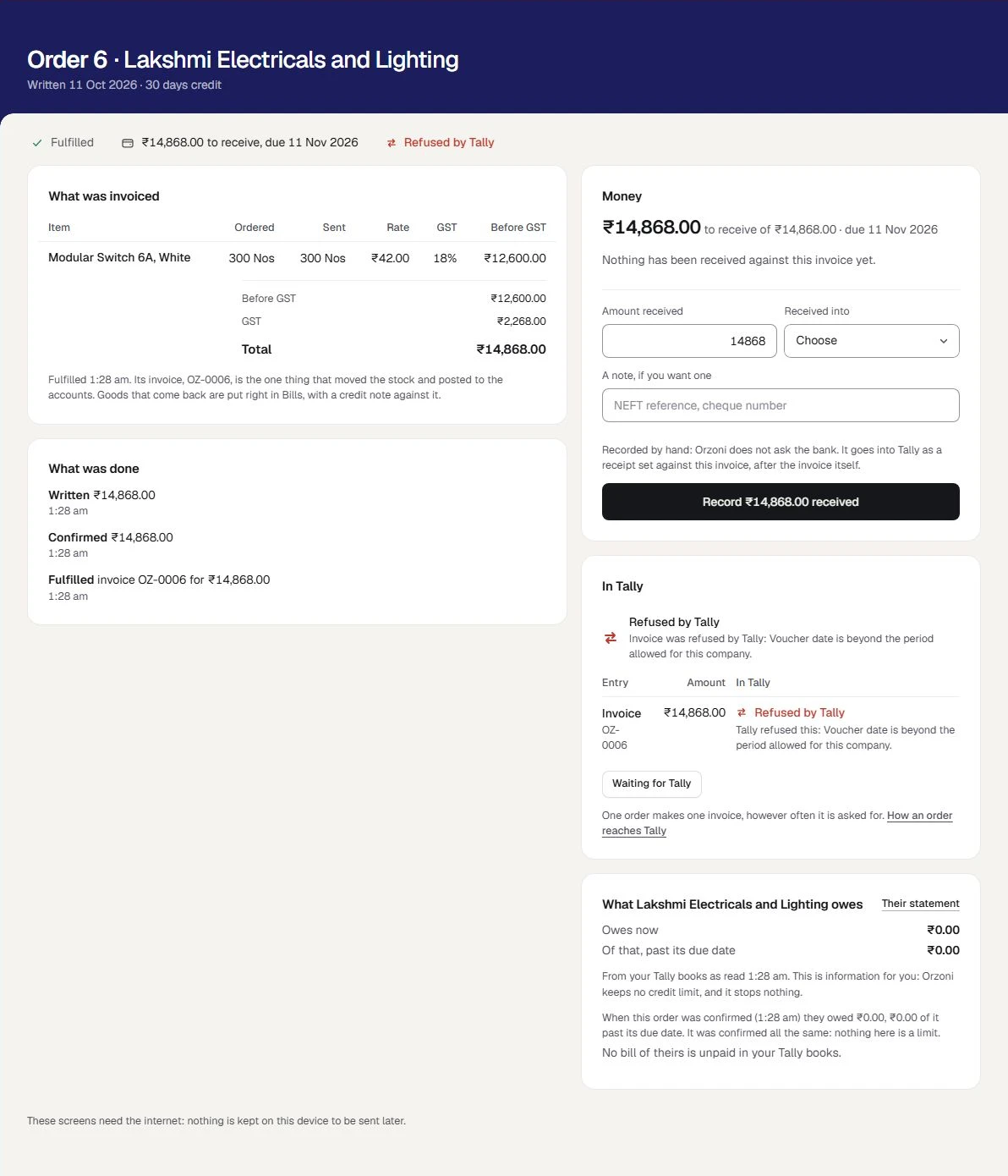
- Read Tally's reason, under Refused by Tally.
- Put the cause right where it is. A date or a ledger is put right in Tally.
- Press Waiting for Tally on the order, or open Connectors, Tally, Waiting for Tally.
- On the invoice's line, press Try again. It is sent once more as it is.
A receipt is not sent ahead of its invoice. While the invoice is refused, a receipt recorded against it reads Waiting for Tally, and follows it in once it is taken. See When a bill is waiting or refused.
When the invoice was discarded
If an order's invoice was discarded from Waiting for Tally before Tally had it, the order reads Not in Tally.
- On the order, in the card In Tally, press Send to Tally again.
The invoice is made once more, under the same bill name, and so is any receipt that was waiting behind it. A small message says Sent. It goes into Tally as soon as the computer that runs Tally can be reached.
An invoice that is waiting, refused, or in Tally is never made a second time from here.
Changed, or removed, in Tally
These mean the invoice, or a receipt, reached Tally and is not there now as it was sent. Someone changed, cancelled or deleted it in Tally. The order is listed under Needs attention.
Orzoni does not change an entry back. The order still shows what was invoiced and what was received. Look at the entry in Tally. If the change was meant, there is nothing to do. If it was not, your accountant puts it right in Tally.
When goods come back, or the invoice was wrong
A fulfilled order is not cancelled or changed. Its invoice is in the books, and is put right there: a credit note against the invoice, made under Bills, as for any other sale. See Change, cancel or delete an entry.
Why there is only ever one invoice
- An order is tied to its invoice once. Pressing Fulfil and invoice twice finds the same invoice and makes no second one, and moves no stock twice.
- Each amount received is recorded once, however often it is sent.
- If the invoice cannot be made, the order is not fulfilled. An order is never marked fulfilled with no invoice behind it.
- The invoice is not opened in the bill form, and cannot be written over from it.
Mistakes you can undo
| The mistake | How to put it right |
|---|---|
| A quantity that cannot go, seen before fulfilling | Lower the confirmed quantity and Save the confirmed quantities |
| An invoice discarded from Waiting for Tally by mistake | Send to Tally again on the order |
| An order fulfilled that should not have been, or goods that came back | A credit note against its invoice, under Bills |
| Money recorded for the wrong amount or account | It is not taken off the order. Tell your accountant, who puts the receipt right in the books. The order then says that entry was changed or removed in Tally |
What it does to your data and to Tally
- In Tally: one sales invoice for each fulfilled order, and one receipt for each amount received. The invoice lowers Tally's stock. Nothing else is written: no delivery note, no sales order, and none of Tally's settings is changed.
- In Orzoni: the order keeps the link to its invoice and receipts, their references and the numbers Tally gave them, and everything done to it under What was done.
- A draft, a confirmed order and a cancelled order make nothing in Tally.
What next
- Write a sales order: writing, confirming and cancelling.
- When a bill is waiting or refused: the Waiting for Tally view in full.
- Payments: money received with no order behind it.
- Customers and suppliers: what each customer owes, and their statement.
What this does not do
- No part delivery and no back order. An order is fulfilled whole, once.
- No delivery note, no challan and no sales order in Tally. The invoice is the one entry.
- No transport details and no e-way bill. E-way bills are made in Tally.
- No warehouse is named on an order. The goods leave as on any sales bill.
- No payment is checked with a bank. Money received is recorded by a person.
- A fulfilled order is not cancelled or changed. It is put right in the books, with a credit note.
- An entry is not changed back in Tally.
- It gives no advice on tax.
The whole list is in Write a sales order.
Still stuck? Write to orzoni.official@gmail.com and say which step you are on, or book a walk-through call.