

Reorder levels and dead stock: what to buy again and what to stop
Set a reorder level from selling speed and lead time, find stock that has stopped moving, and decide what to do with it, with the arithmetic shown.
On this page
There is a rack of forty pedestal fans at the back of the godown. They came in March, sold well until the rains, and the last one left on the sixth of July. On the next rack, the space for LED battens is empty, and three electricians were sent to the shop down the road this week. The godown is full and you are out of stock, on the same afternoon.
Both problems come from buying by feel. Both have the same cure, which is two numbers for each item and a date in the diary.
The first number is the reorder level: average daily sale multiplied by lead time in days, plus a buffer. When stock touches it, you order. The second is a date: an item with stock on the shelf and no sale for 90 days is dead stock, and it gets a decision, not another month. This post works both out in full, with a fan and a batten, and then goes through the four things you can do with stock that has stopped.
Selling speed: units a day over the last 60 days
Everything starts with how fast an item sells. Take the quantity sold in the last 60 days and divide by 60.
The LED batten 20W sold 540 pieces in the last 60 days. That is 9 a day.
Sixty days is a working compromise. A week is too jumpy: one contractor's order doubles it. A year is too slow: it averages summer into winter. Sixty days smooths out a festival week and still follows the season.
From selling speed comes the figure you will use most: days of stock left. Stock on hand divided by daily sale. With 135 battens on the shelf, 135 / 9 = 15 days.
Three things spoil the figure. Correct for them by hand when they matter.
- Days you were out of stock. If the batten was out for 12 of the 60 days, it sold 540 in 48 days, which is 11.25 a day, not 9. Zero sales on an empty shelf tells you nothing about demand.
- One large order. A builder took 200 pieces for one site. Take it out: 340 in 60 days is 5.7 a day from regular trade. Then decide whether such orders come often enough to plan for.
- Season. For fans, coolers, geysers and rain goods, the last 60 days are the wrong 60 days. Use the same two months of last year, and what this year's season has done so far.
Lead time: from deciding to order to goods on the shelf
Lead time is not the transporter's promise. It is every day between noticing you are low and having the goods counted, binned and ready to sell.
| Step | Days |
|---|---|
| You notice, and get round to ordering | 2 |
| The supplier confirms, packs and bills | 2 |
| On the road | 3 |
| Unloading, checking, entering the purchase | 1 |
| Lead time | 8 |
Measure it from your own records. Take the last five purchases of the item, and for each one count the days from your order message to the date on the purchase entry. Use the usual figure for the reorder level, and note the longest. For the batten the usual is 8 days and the longest in the past year was 12.
The reorder level, worked
The reorder level has two parts.
- What you will sell while you wait: daily sale x lead time = 9 x 8 = 72 pieces.
- A buffer for a late lorry or a busy week, called safety stock. Take four days' sale for now: 9 x 4 = 36 pieces. The next section shows where four days comes from.
Reorder level = 72 + 36 = 108 pieces. When the count touches 108, the order goes out that day.
Next, how much to order. A simple rule that works for most trading items is thirty days of sale: 9 x 30 = 270 pieces, which for this item is nine cartons of 30.
The picture is called a saw-tooth, and reading it once is worth more than the formula.
| Day | What happens | Stock |
|---|---|---|
| 0 | Starting stock | 378 |
| 30 | 30 days at 9 a day have gone: 378 less 270. Stock touches the level and the order is placed | 108 |
| 38 | 8 more days at 9 a day: 108 less 72. The goods arrive just as the buffer is reached | 36 |
| 38 | 270 pieces are added | 306 |
| 60 | 22 days at 9 a day: 306 less 198. Order again | 108 |
| 68 | The goods arrive | 36, then 306 |
Three things follow from the picture.
- If everything goes to plan, the buffer is never touched. The 36 pieces are there for the lorry that takes 12 days or the week that sells 12 a day.
- Stock swings between 36 and 306, so on an average day you hold about 171 pieces: the buffer plus half an order. That is what the item costs you in cash. Order sixty days at a time and the average climbs to 306.
- The level moves when the facts move. If sales rise to 12 a day, the same sum gives 12 x 8 + 12 x 4 = 144. A level set once and never looked at is how the batten rack went empty.
Safety stock, and when not to carry it
There are two honest ways to size the buffer.
The delay method. Ask how many days late this supplier has ever been. The batten usually takes 8 days and once took 12, so 4 days late. Buffer = 4 x 9 = 36 pieces. It is simple, and it is good enough for most items.
The worst-case method. Assume the busiest selling rate and the longest lead time arrive together, and cover the gap between that and a normal wait.
- Busiest fortnight: 12 a day. Longest lead time: 12 days. Worst case = 12 x 12 = 144 pieces.
- Normal wait = 9 x 8 = 72 pieces.
- Buffer = 144 less 72 = 72 pieces, and the reorder level becomes 72 + 72 = 144.
The second method doubles the buffer. Whether that is worth it depends on what a day out of stock costs you, and that depends on the item.
Sort your items by the value they sold, largest first, and add up the sales as you go down the list. The few items that make the first 80% of sales are Grade A. The next 15% are Grade B. The long tail that makes the last 5% is Grade C.
| Grade | In a shop of 400 items | Buffer to carry | How often to look |
|---|---|---|---|
| A | About 60 items that bring 80% of sales | The worst-case buffer. Never run out of these | Every week |
| B | About 100 items, 15% of sales | The delay method | Every fortnight |
| C | About 240 items, 5% of sales | None, or one pack | Once a month |
Carry no buffer at all when:
- a local distributor can supply the item the same day;
- the item is bulky and slow, so the space costs more than the lost sale;
- a new model is coming and the old one will be hard to sell;
- you stock it for one customer, who gives you notice.
In the picture, Grade C is 240 items holding 30% of the stock value for 5% of the sales. That is where the money for the missing battens is sitting.
Dead stock against slow stock
They are different problems and need different answers.
Slow stock is selling, but you hold too much of it. A working test is more than 45 days of stock at the current selling rate. The modular switch sells 20 a day and you hold 2,400: that is 120 days of stock. Nothing is wrong with the item. The answer is to stop reordering until the count comes down, and to ask why 2,400 were bought. A discount would be the wrong answer.
Dead stock has stopped. The test is a date: stock on the shelf and no sale for 90 days, or never sold at all. The pedestal fans last sold on 6 July. On 11 October that is 97 days. They are dead stock by a week, and the arithmetic says so even if the season explains it.
A date is better than an opinion because every owner has a reason why a particular item will move soon. The date does not argue.
Then look at stock by age, counted from when each item last came in.
In this godown ₹8,40,000 of ₹42,00,000 has sat for more than 90 days. That is one rupee in five. If your overdraft costs 12% a year, it costs ₹8,400 a month to keep it there, and it occupies the racks the fast items need.
Stock dies for a short list of reasons, and each is a buying habit to change: bought in bulk for a scheme discount, bought for a season that ended, a model the maker replaced, a customer's special order that was cancelled, a minimum order quantity far above what you sell, or the same item sitting under two names so that nobody saw how much there was.
What to do with dead stock: four ways, in rupees
Take the forty fans. They cost ₹2,000 each, so ₹80,000 is on the rack. They sell at ₹2,500 in season. There are four ways out, and each has a price.
1. Return it to the supplier
Ask first, because it recovers the most. A supplier who wants your next season's order will often take stock back, less a cut. At 90% you recover ₹72,000 and lose ₹8,000, plus freight.
The paperwork has a clock on it. Under Section 34 of the CGST Act, when "the goods supplied are returned by the recipient", the supplier may issue a credit note, and its details must be declared no later than "the thirtieth day of November following the end of the financial year in which such supply was made", or the date of the annual return if that is earlier. For fans bought in March 2026 that date is 30 November 2026. So October is the month to ask, not January. On your side, the input tax credit you took on those fans is reversed against the credit note.
2. Sell it at a clearance price
GST is charged on what you actually charge. Section 15 values a supply at "the price actually paid or payable", and a discount given at the time of sale stays out of the value when it is "duly recorded in the invoice". At ₹1,700 a fan the bill shows ₹1,700, tax at 18% of ₹306 on it, and ₹2,006 to pay. The CBIC's circular on sales promotion schemes says the supplier keeps the input tax credit on goods sold under such discounts.
Forty fans at ₹1,700 bring ₹68,000. You lose ₹12,000 against cost.
Who buys them: another dealer in a town where the season runs later, the customers who bought the same fan from you before, or the walk-in customer who sees one fan on the counter with a plain price on it.
3. Bundle it with something that sells
A fan with a regulator at one price, or a fan with two LED bulbs. The same circular deals with "Buy One, Get One Free" offers: it is "not an individual supply of free goods but a case of two or more individual supplies where a single price is being charged for the entire supply", and credit stays available. The rate on a bundle depends on what is in it, so settle that with your accountant before you print the offer.
4. Write it off
This is the last resort, and it costs more than the stock. Section 17(5)(h) of the CGST Act says input tax credit is not available on "goods lost, stolen, destroyed, written off or disposed of by way of gift or free samples". If you bought the fans at ₹2,000 plus 18% and took the ₹360 of credit on each, writing off forty means giving up 40 x ₹360 = ₹14,400 of credit on top of the ₹80,000. Giving them away has the same effect. In the books a write-off is a stock journal. Your accountant will tell you how and when the credit is reversed.
| Way out | Cash recovered | What it costs you |
|---|---|---|
| Return to supplier at 90% | ₹72,000 | ₹8,000 and freight |
| Clear at ₹1,700 each | ₹68,000 | ₹12,000 |
| Write off | nil | ₹80,000 and ₹14,400 of credit |
Hold or clear: the sum
The honest alternative to all four is to wait for next summer. Sometimes that is right. Do the sum both ways.
Hold. If all forty sell at ₹2,500 next summer, the margin is 40 x ₹500 = ₹20,000. The season is about five months away, and five months of interest on ₹80,000 at 1% a month is ₹4,000. You are left with ₹16,000.
Clear. At ₹1,700 you lose ₹12,000 now and have ₹68,000 in hand. Put that into fast items that turn every 50 days at a 10% margin and it earns ₹6,800 three times in those five months: ₹20,400. You are left with ₹8,400.
On those figures, holding wins by ₹7,600. Now change one assumption. Suppose only twenty sell at full price next summer, because a new model with a better star label has arrived, and the other twenty are cleared at ₹1,700 anyway. The margin is 20 x ₹500 = ₹10,000, the loss is 20 x ₹300 = ₹6,000, the interest is still ₹4,000, and you are left with nothing, a year later.
So the rule is not "always clear". Hold a seasonal item that will be the same item next season, if you have the space and the cash. Clear anything that will be superseded, anything not tied to a season, and anything you have already held through one full year.
Godowns and packs
Two details trip up a reorder level that is otherwise right.
More than one godown. Set the level on the item's total across godowns, because that is what decides whether you must buy. A shop counter that runs low while the main godown is full needs a transfer, not a purchase. Keep a separate, smaller refill mark for the counter and move stock to it on a fixed day.
Packs. The level is in the unit you count in, and the order is in the unit the supplier packs in. The batten's level is 108 pieces and its order is nine cartons of 30. If you also sell an item in packs of your own making, say wire by the metre and by the 90 metre coil, the level belongs to the loose item, and every coil sold takes 90 metres off it.
The reorder list, grouped by supplier
A level is only useful if someone looks. The routine that works is a list once a week, on a fixed day, of every item at or under its level, grouped by the supplier it comes from, because you order from suppliers and not item by item.
For each supplier, one message:
Asking for the dispatch date on every order is how you come to know your real lead time.
This weekly list is what the Reorder screen in Orzoni is. It is worked out from your Tally books and changes nothing in them.
- An item is listed when its stock is at or under the Reorder at level you set on its page. With no level set, it is listed when under 15 days of stock are left at the rate it sold over the last 60 days.
- The list is divided by supplier: the one you set as Usually bought from, or the one the item was last bought from. Each row says what is in stock, why it is listed (under its level, so many days left, or out of stock), how much to order and what that costs at the last rate paid.
- The quantity is the Order this many you set. With none set, it is enough for 30 days at the rate the item sells, less what is in stock.
- A button beside each supplier puts the order into a WhatsApp message, with your business's name, each item and its quantity, and a request to confirm the rate and the delivery date. You read it, change it if you like, and send it from your own WhatsApp.
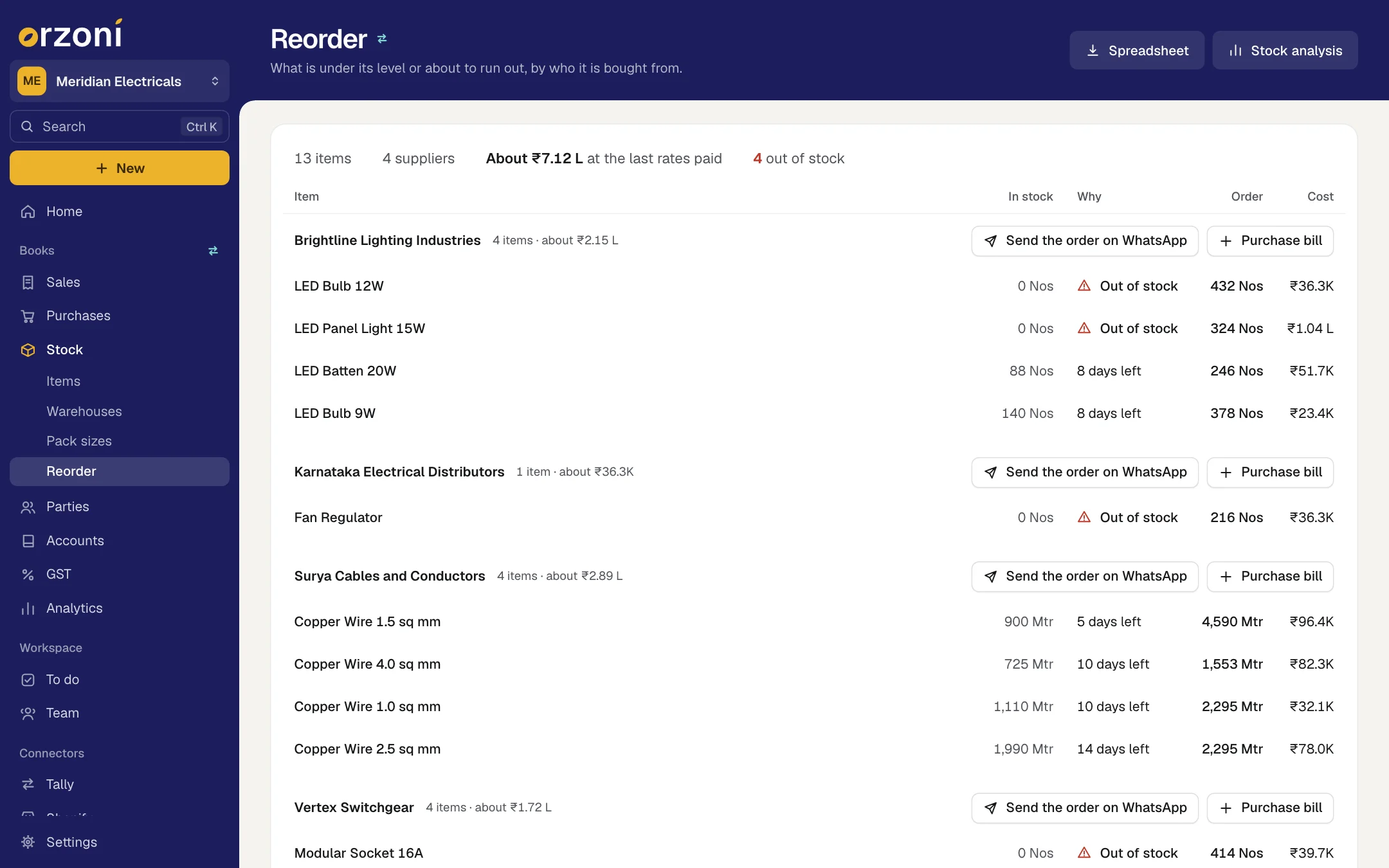
For the batten, the two rules give different answers, which is why setting your own level is worth the minute. The 15-day rule lists it when stock falls under 135 pieces. Your worked level is 108, or 144 if you give it the worst-case buffer.
Know what the list does not do. Sending the order records nothing in Tally, and Orzoni does not make a purchase order: when the goods arrive, you enter the supplier's purchase bill. The levels you set are kept in Orzoni and are not written to Tally.
The reading side is under Analytics, then Stock, in five views: Overview, Best sellers, Age of stock, Cost changes and Landed cost. Best sellers grades every item A, B or C on the 80, 15 and 5 split used above. Age of stock lists what has not sold for 90 days or has never sold, largest value first, with the same age bands as the picture. The analytics board also has a slow-moving tile for items with over 45 days of stock.
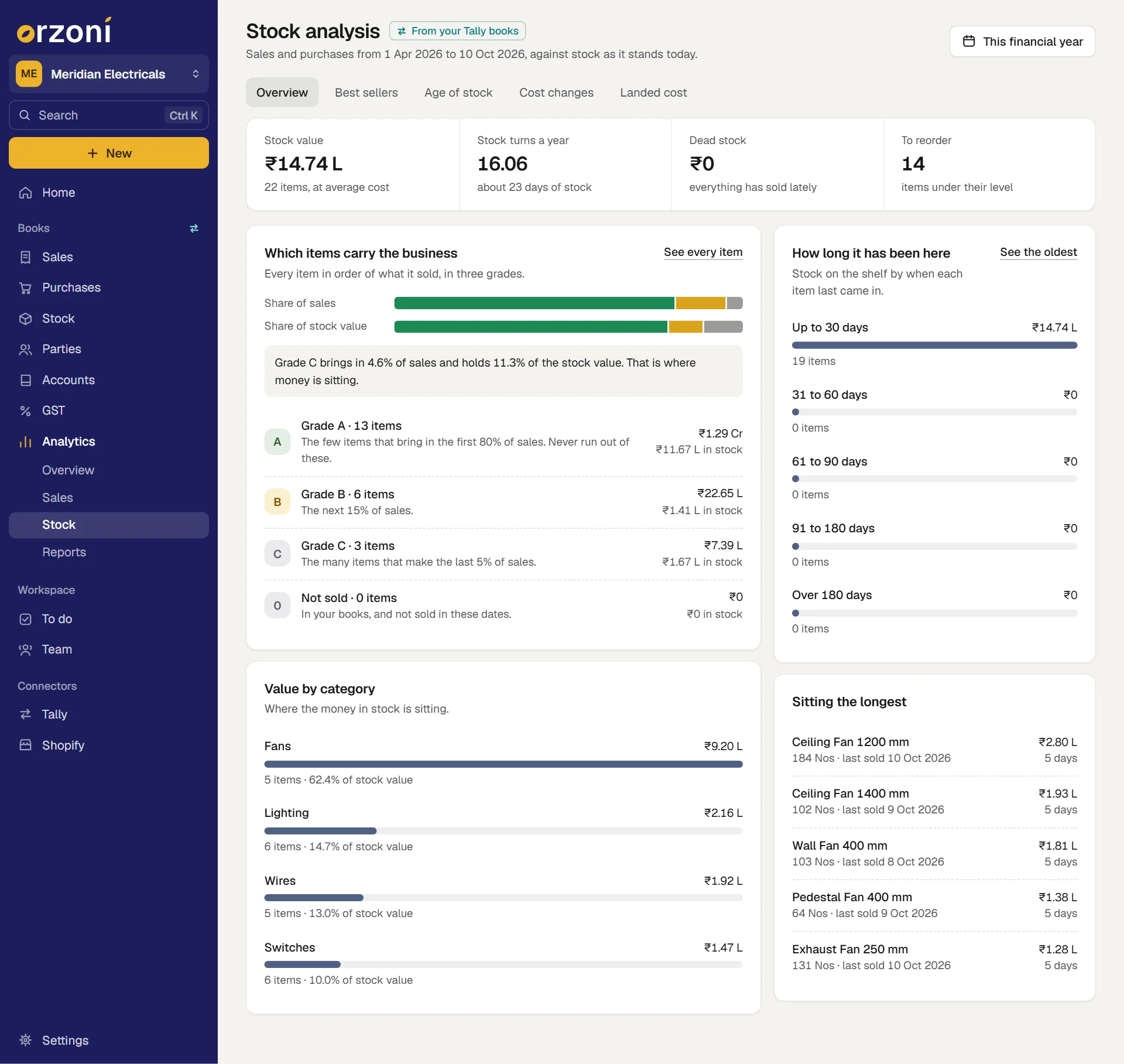
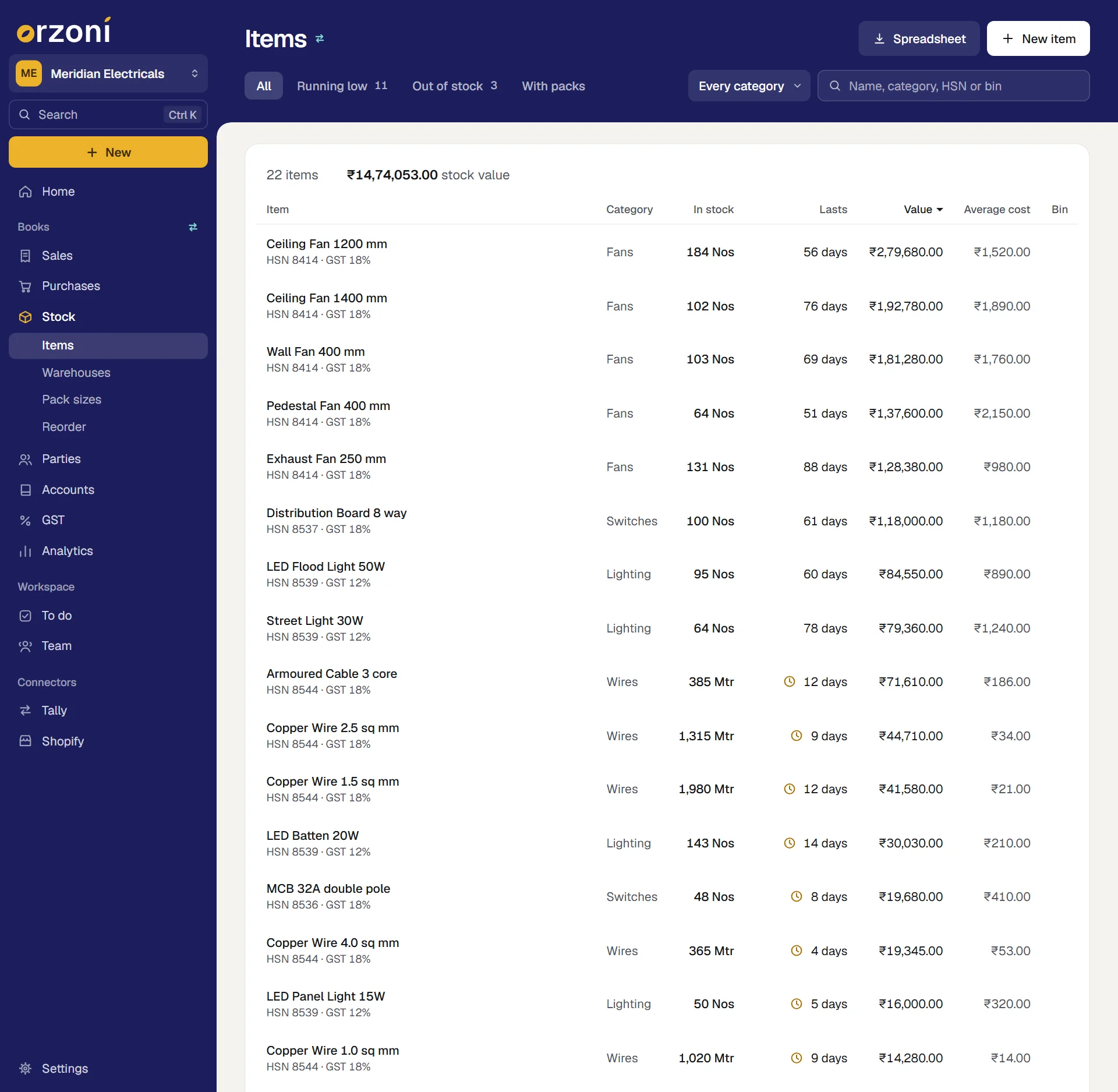
The guides have every step: Reorder and stock analysis, Items, Warehouses and pack sizes and Analytics.
A review date every month
Put one hour in the diary on the first Monday of each month.
- Grade A items. Compare each level with the last 60 days of sale. Raise it where sales have risen, lower it where they have fallen.
- Lead times. Any supplier who was late twice gets a longer lead time in your sums, or a call.
- The dead stock list. One decision for each item, with a date: return, clear, bundle, or hold until a named month. "Wait and see" is not on the list.
- Slow stock. No reorder until the count is under 45 days.
- Seasons. Six weeks before a season, raise the levels of its items. A month before it ends, stop reordering them and sell down what you have.
- New items. Three months after an item is introduced, grade it. If it is not selling, it goes on the dead stock list like any other.
Then ask the one question that covers all of it: of the money in the godown, how much is in items that sold this month?
Questions people ask
How is a reorder level different from a reorder quantity?
The level is when to order: the stock figure that triggers it. The quantity is how much to order when it does. For the batten, the level is 108 and the quantity is 270.
I have 400 items. Must I set a level on each?
No. Set levels on the Grade A items, about sixty of them, where running out costs you most. Let the rest run on days of stock: order when under 15 days are left. Add levels to B items as you get to them.
Is anything unsold for 90 days really dead?
Not always. A spare kept for a machine you sold, or material held for a running project, can sit for months with good reason. Mark those so they stay off the list. Everything else at 90 days gets a decision, because the money tied up is the same whatever the reason.
What are stock turns, and what is a good number?
Stock turns say how many times a year your stock is sold and replaced: the cost of goods sold in a year divided by the stock value. If goods costing ₹35,00,000 went out in the last 60 days and the stock is worth ₹42,00,000, a day's sales cost ₹58,333, so you hold 42,00,000 / 58,333 = 72 days of stock, which is 365 / 72 = about 5 turns a year. There is no one good number: it differs by trade. Watch whether your own figure is rising or falling.
Should I buy more to get the scheme discount?
Work out the days of stock the scheme quantity gives you. Say the scheme gives 3% extra for buying 120 days of an item you would otherwise buy 30 days at a time. Your average holding goes from 15 days of stock to 60, so you carry 45 days more for four months. At 1% a month that is 45 x 4% = 1.8 days' worth of the item, or 1.5% of the 120-day purchase. Half the discount goes on interest, before you count the rack space and the risk that the last third never sells. Take a scheme on a Grade A item that never stops selling. On anything else, do the sum first.
Open the list and check the top ten
Take your ten largest-selling items today. For each, write down the daily sale over the last 60 days, the real lead time and the level that follows. Then walk to the back of the godown, find the rack nobody has touched since summer, and give it a date.
In Orzoni, open Reorder and check the top ten items: the list is grouped by supplier, with the days left. Nothing is charged today, as Pricing explains. If your count itself is in doubt, start with Why your store's stock does not match the godown.
Facts and sources
The arithmetic in this post is standard stock-keeping and the figures are examples. The points of law were read on the sources below on 11 October 2026.
| What | Source | Read on |
|---|---|---|
| Credit note when goods are returned; declared by 30 November after the financial year of the supply, or the annual return if earlier | Section 34, CGST Act: taxinformation.cbic.gov.in, section 34 | 11 Oct 2026 |
| Value of a supply is the price actually paid or payable; a discount recorded in the invoice stays out of the value | Section 15(1) and 15(3)(a), CGST Act: taxinformation.cbic.gov.in, section 15 | 11 Oct 2026 |
| No input tax credit on goods lost, stolen, destroyed, written off or given as gifts or free samples | Section 17(5)(h), CGST Act: taxinformation.cbic.gov.in, section 17 | 11 Oct 2026 |
| Discount offers and "Buy One, Get One Free": how they are treated, and that the supplier's credit stays available | CBIC Circular No. 92/11/2019-GST, 7 March 2019: gstcouncil.gov.in | 11 Oct 2026 |
| How Orzoni's Reorder list and Stock analysis work out their figures: 15 days at the 60-day rate, 30 days to order, dead stock at 90 days, the A, B and C split | Orzoni's guides: Reorder and stock analysis, Items | 11 Oct 2026 |
Assumptions made for the sums, which you should replace with your own: money costs 12% a year, fast items turn every 50 days at a 10% margin, and the fans carry 18% GST. Left out on purpose: any industry figure for how much stock a typical business holds dead, because we found none we could trace to a source; and formulas that need a statistics course to use.

Guides this post leans on
The Reorder list grouped by supplier and sent on WhatsApp, and the five views of Analytics, Stock, with how each figure is worked out.
Read the guide ItemsEvery stock item in your Tally books with what is in stock and what it is worth, one item's page, and how to add, alter or hide an item.
Read the guide Warehouses and pack sizesTally's godowns with what each holds, bins and pick lists, moving stock or correcting a count, and keeping one count of an item you sell in packs.
Read the guide AnalyticsYour figures as pages of tiles. What every tile on Overview, Sales, Repeat buyers and Workspace shows, how repeat buyers are worked out, what the colours mean, how the dates work, and how to arrange each page your own way.
Read the guide