

Collecting dues politely on WhatsApp, without losing the customer
When to send the first payment reminder, what to write, when to call instead, and how to keep the customer, with sample messages to send yourself.
On this page
It is Sunday evening and the outstanding list is open. ₹18 lakh is past due. At the head of the list is a builder who has bought from you for six years, whose site supervisor knows your godown boy by name, and whose oldest bill is ninety days old today. You have typed a message to him twice and deleted it twice, because every wording sounds either like begging or like a threat.
The answer is mostly timing. Ask early, name the bill, and move from messages to a phone call by the fifteenth day. A reminder sent the day after a bill falls due, with the invoice number, the amount and the date in it, reads as good housekeeping. The same reminder sent after sixty days of silence reads as an accusation. The customer has not changed in between. You have only waited too long.
This post gives a schedule from the day the bill is made, wordings a decent person would actually send, what to say on the call, what to do with a promise, and how to keep track. It also sets out what WhatsApp's own rules allow, because a number that gets banned collects nothing.
Late payers are usually forgetful, not dishonest
Look at why bills of good customers go unpaid, and most of the reasons have nothing to do with intent.
- The bill never reached the person who pays. It went to the site, or to the owner's phone, and the accountant has not seen it.
- There is a query nobody told you about. Two pieces short, a rate that differs from the quotation, a wrong GSTIN, so their accounts team has parked the bill.
- They pay on a fixed day. Many firms run payments once or twice a month. A bill that misses the run waits for the next.
- They are waiting for their own customer. A real squeeze, usually short.
- They forgot.
A specific reminder solves the first three at once. It puts the bill in front of the right person, it invites the query, and it gets you into the next payment run. That is why the first message is a service to the customer and not a demand.
Waiting has a price. If your overdraft costs you 12% a year, ₹18,00,000 standing with customers costs ₹18,000 a month in interest alone, before you count the supplier you could not pay on time.
It also helps to see the ₹18 lakh by age, because each age asks for something different.
| How late | What it usually means | What to do |
|---|---|---|
| Not due yet | Nothing | Make sure they have the bill |
| 1 to 7 days | Forgotten, or missed a payment run | A short reminder with the bill number |
| 8 to 15 days | Parked, or waiting | A second message with every unpaid bill listed |
| 16 to 30 days | Something is in the way | A call, and a date |
| 31 to 60 days | A cash problem or a dispute | Owner to owner, and new credit waits |
| 61 to 90 days | A habit forming | A visit, and a plan in writing |
| Over 90 days | A risk | A written demand, after advice |
The money on the top rungs is the easy money. It is tempting to spend your energy on the bottom rung, where it is hardest to collect, and let the top rungs age into it.
Before the due date: the invoice itself
Collection starts on the day of the bill.
- Agree the credit days before the first sale, and print them on every invoice: "Payment due in 30 days" and the date itself.
- Send the bill on WhatsApp the day it is made, with the PDF, to the person who pays as well as the person who ordered. Ask once who that is and save the number.
- Put the ways to pay on the bill: bank account and IFSC, and a UPI ID if you take it.
- Ask, the first time, whether you may send bills and reminders on that number. Almost everyone says yes, and it matters, as the next section shows.
A message that travels with the bill:
The last sentence is the useful one. A query raised on day one is fixed in a day. The same query found on day forty costs a month.
For a large bill, a courtesy note three days before the due date is fair: "Invoice 0412 for ₹84,370 falls due on Friday. Is there anything you need from our side?" Do this only for amounts that matter. A nudge before the due date on every small bill is a nuisance.
What WhatsApp itself allows
Everything in this post is one person sending a message to one customer from their own number. That is the use WhatsApp is built for, and it keeps you well inside its rules. A few facts from WhatsApp's own help pages are worth knowing.
Two apps. WhatsApp Messenger is the ordinary one. The WhatsApp Business app is a separate, free-to-download app that WhatsApp says was "built with the small business owner in mind". It adds a business profile, where customers can see your business name, description, address, business hours and category. One phone number cannot be on both apps at the same time.
Quick replies. In the Business app you can save messages you send often and call each up with a shortcut. The help page puts the limit at 50 stored quick replies. Save the wordings from this post as quick replies and then fill in the bill number and amount each time.
Labels and lists. The Business app lets you mark chats so that you can find them again. WhatsApp's page notes that labels are now becoming lists. A list named "Payment due" keeps the chats you are chasing in one place.
A link that opens a chat with the words written. WhatsApp calls this click to chat. A link of the form https://wa.me/ followed by the full number in international format opens a chat with that number, and a message added to the link "will automatically appear in the text field of a chat". Nothing is sent until the person presses send. This is how billing software can open your WhatsApp with a reminder already written.
The ticks. One grey tick means sent, two grey ticks delivered, two blue ticks read. A blue tick tells you the message was seen. It does not tell you the bill is agreed.
Broadcast lists. A broadcast list sends one message to up to 256 contacts, each of whom receives it as an individual message. WhatsApp's page adds a condition: "Only people who've added you to their phone's contacts will receive your broadcast message." A broadcast suits a notice that your godown is closed for Diwali. It does not suit reminders, where every customer has a different bill and amount.
What gets a number into trouble
WhatsApp's help centre says it plainly: "Our products are not intended for bulk or automated messaging, both of which have always been a violation of our Terms of Service." The same page says WhatsApp identifies and bans accounts for it. Tools that promise to push reminders to five hundred customers from your own number, by themselves, in the night, are the thing that page describes. A banned number is one your customers can no longer reach you on.
Meta's Business Messaging Policy, which covers the Business app, has two lines a creditor should know:
- "You may only contact people on WhatsApp if: (a) they have given you their mobile phone number or username; and (b) you have received opt-in permission from the recipient confirming that they wish to receive subsequent messages or calls from you."
- "You must respect all requests (either on or off WhatsApp) by a person to block, discontinue, or otherwise opt out of communications from you via WhatsApp."
Hence step 4 above. And if a customer asks you to stop messaging, stop, and move to a call, an email or a letter.
Day 1 after the due date: the first reminder
Send it on the first working day after the due date, between half past ten and noon. Avoid Sundays, late evenings and festival days.
Four rules make it easy to read and hard to resent.
- One bill, three facts: the invoice number, the amount, the due date.
- Attach the bill again. Nobody wants to search for it.
- An easy way out: "if it is already paid, please ignore this". It lets a careful customer keep their dignity.
- No adjectives. Not "long pending", not "urgent", not "kindly do the needful at the earliest".
To a customer you know well, the same thing in a warmer voice:
Then leave it alone for a week. One message, not three.
Day 7: the second reminder, with the full list
If a week passes, the bill is not simply forgotten. The second message changes two things: it lists everything unpaid, so the customer sees the whole account, and it asks for a date instead of asking for payment. "When" is a question a person can answer. "Please pay" is not.
Notice what the list does. It shows that only one bill is late, which is fair to the customer, and it shows that two more are coming, which is fair to you.
Day 15: call, and what to say
Two unanswered messages are the limit of what messages can do. A third makes you easy to ignore, and a fourth makes you a pest. On the fifteenth day, call. Call the person who decides, at a time they can talk, and keep it to five minutes.
- Ask before you tell. "I wanted to check on invoice 0412. Is there any problem with the bill or the material?" If there is a shortage, a rate difference or a wrong detail, you have found the real reason. Settle it first: a corrected bill or a credit note, that week.
- Ask for a date and an amount. "Which day can I expect it, and will it be the full ₹84,370?" Do not accept "next week". Next week has seven days.
- Say it back. "So ₹84,370 by Monday the 5th. I will note that."
- Confirm it in writing the same day, in the same chat.
What not to say on the call: anything about their other suppliers, their new car, or what you have heard in the market. Keep to the bill.
The promise to pay, and what to do when it is broken
A promise is the most useful thing a collection call produces, and it is lost within the hour when nobody writes it down. Record four things: who promised, how much, by which day, and how you asked.
On the promised day, look first thing in the morning. If the money has come, record it and say thank you in the chat. People repeat what they are thanked for.
If the day passes, call the same day or the next morning. Do not let a broken promise sit for a week, because that tells the customer your dates are soft.
The second promise should be nearer than the first. After two broken promises, change the terms and stop repeating the question: part now and the rest on a fixed day, or the next supply against payment.
Day 30 and after: firm, and still civil
At a month past due the conversation moves up a level and the supply terms change.
- Owner speaks to owner. Not your accountant to theirs.
- New credit waits. Say it as a fact, not a punishment: "I can send the next lot against payment until 0412 is cleared." Many an old bill is cleared the day new material is needed.
- Offer a plan. "Half this Friday, half on the 25th" in writing is worth more than a promise of the whole amount on no date.
After about 45 days with no plan, put it on paper: a letter on your letterhead with the bills listed, sent by email and shared as a PDF in the chat. Beyond that, take advice before you act.
Some things are never worth it at any stage: messaging the customer's staff or family, posting in a trade group, or sending ten messages in a day. They do not bring the money sooner, and they end the relationship.
What the published rules say
Three pieces of law are worth knowing about, to raise with your accountant and never as a threat in a chat.
- A GST-registered buyer has 180 days. Under the second proviso to Section 16(2) of the CGST Act, a buyer who has taken input tax credit on your invoice and "fails to pay to the supplier" the value and the tax "within a period of one hundred and eighty days from the date of issue of invoice" must pay back that credit with interest. Rule 37 says the credit can be taken again once the payment is made. For invoice 0412 of 12 August 2026 the 180 days end on 8 February 2027. A buyer's accountant knows this rule, and a calm mention of the date at five months is reasonable.
- Small suppliers have the MSMED Act. The Ministry of MSME's Samadhaan page says a buyer must pay a micro or small enterprise within 45 days of accepting the goods or services, failing which the buyer "is liable to pay compound interest with the monthly rests" at three times the bank rate notified by the Reserve Bank, and that "Any Micro or small enterprise having valid Udyam Registration can apply". New applications are filed on the Ministry's online dispute resolution portal. Read the fine print for a trading business: retail and wholesale traders were brought into Udyam registration in July 2021 "for the limited purpose of Priority Sector Lending", in the Reserve Bank's words. Ask your accountant whether this route is open to you before you rely on it.
- Interest you charge is part of the sale. Section 15(2)(d) of the CGST Act includes "interest or late fee or penalty for delayed payment of any consideration" in the value of a supply. So interest billed to a customer carries GST. Ask your accountant how to bill it before you add a line.
Part payments, and what to settle first
Take a part payment every time it is offered. It lowers what is at risk and it keeps the customer in the habit of paying you. Then do two things the same day: thank them, and state the balance in writing.
Which bills does a part payment settle? The fair and usual answer is the oldest first. It stops one old bill from going stale while newer ones are cleared around it.
Say that, on 5 October, the customer with the three bills pays ₹1,00,000 in place of the ₹84,370 promised.
| Invoice | Amount | Settled by the ₹1,00,000 | Still unpaid |
|---|---|---|---|
| 0412 of 12 Aug | ₹84,370 | ₹84,370 | nil |
| 0455 of 29 Aug | ₹62,540 | ₹15,630 | ₹46,910 |
| 0503 of 18 Sep | ₹39,090 | nil | ₹39,090 |
| Total | ₹1,86,000 | ₹1,00,000 | ₹86,000 |
If the customer says the money is for one particular bill, say a disputed one is to be left aside, respect that and record it that way.
Keeping track: who was asked, and what was said
None of this works from memory. With forty customers owing, you need to know every morning who promised today, whose promise was broken, and who has not been asked at all.
A ruled notebook or a spreadsheet does the job if it has these columns: customer, amount past due, days late, how you last asked (message, call or visit), what was said, promised date, promised amount. Sort it each Monday. Half an hour a week on this list is worth more than a day of angry calls at month end.
Orzoni keeps the same diary beside your books, so the amounts are never typed twice.
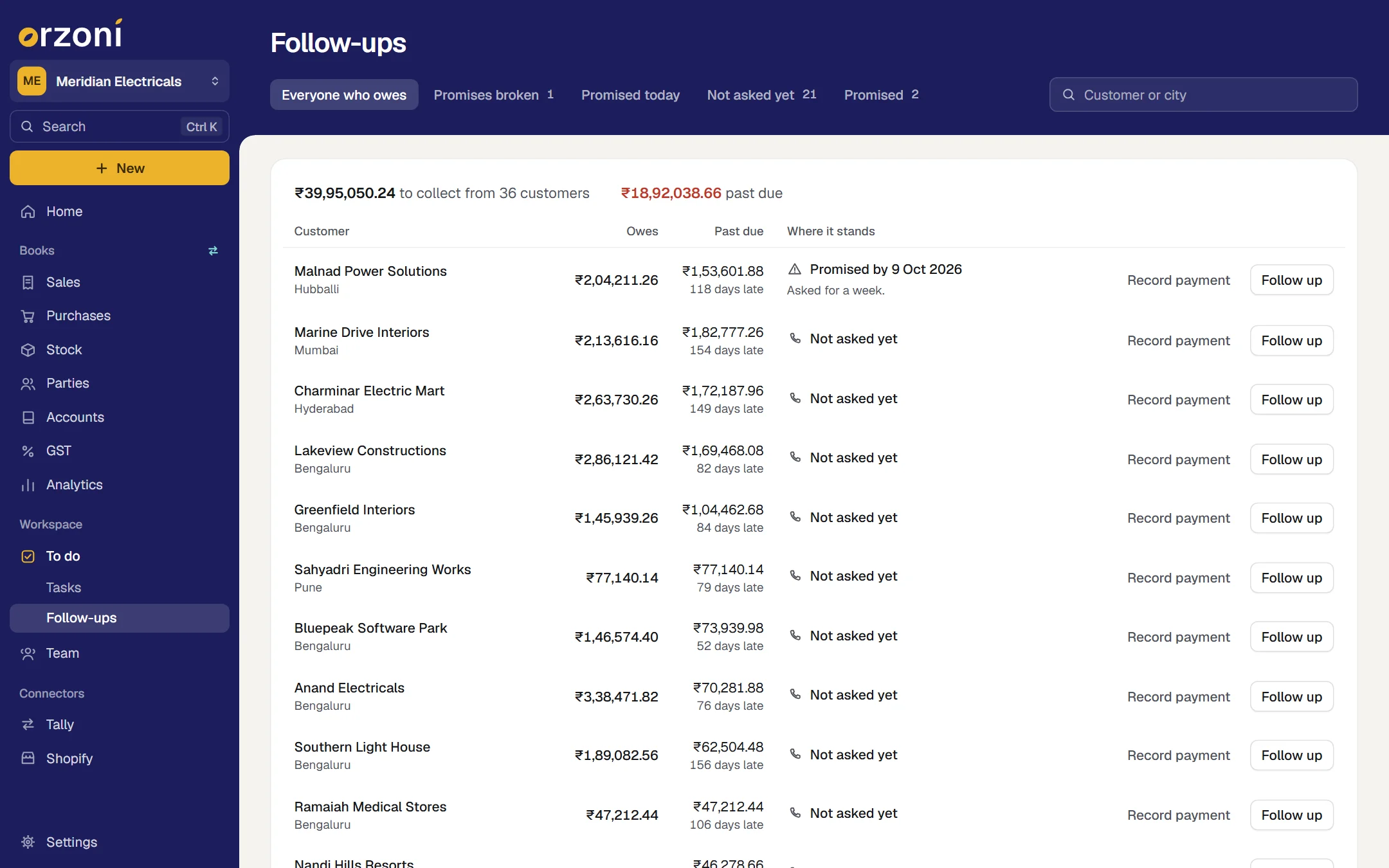
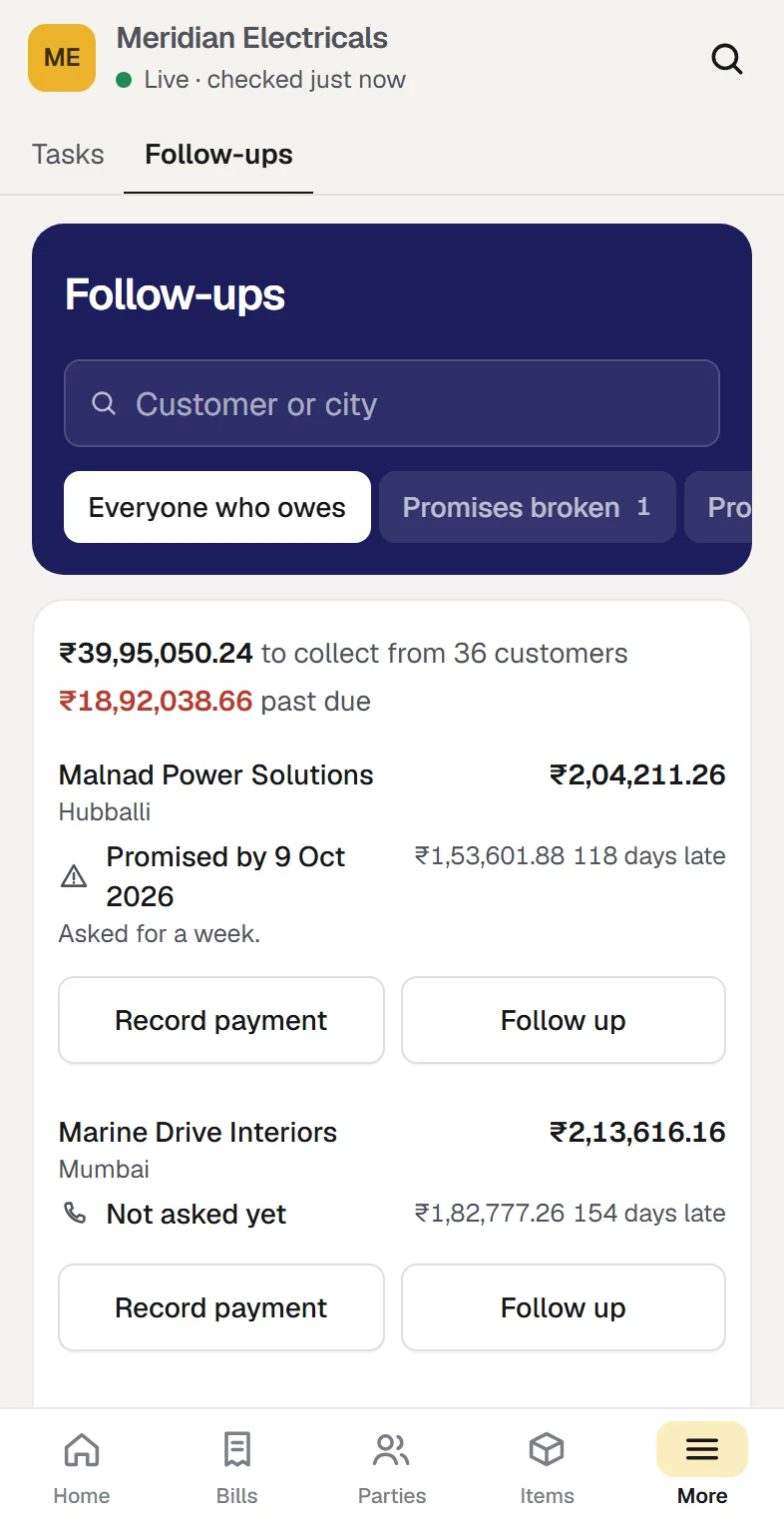
- Follow-ups lists every customer who owes you, from your Tally books, with what they owe, how much is past due and how many days late the oldest bill is. Broken promises come first, then promises due today, then customers nobody has asked yet.
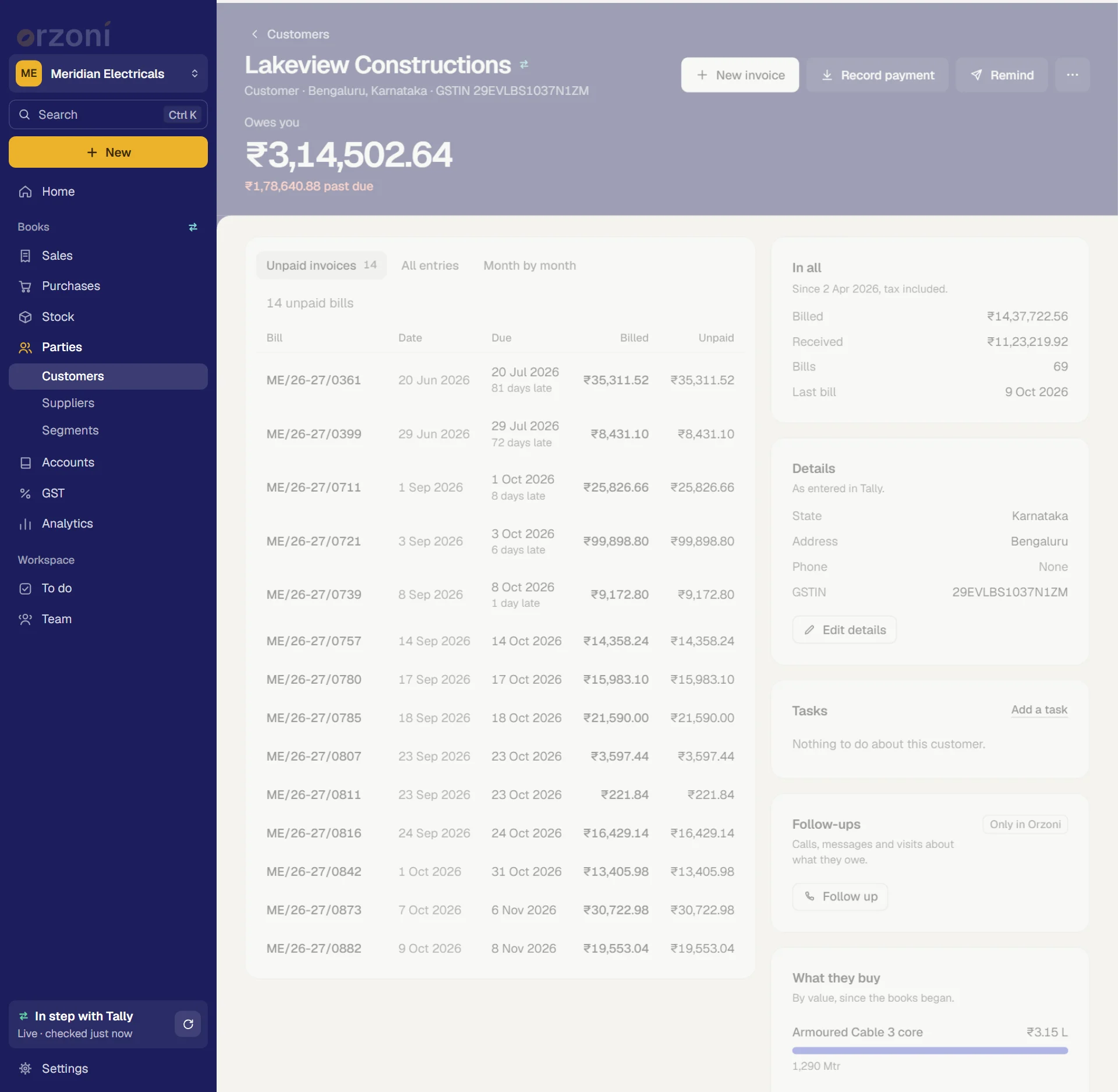
- Remind, on a customer's page, writes the WhatsApp message for you: what is unpaid in all, then a line for each unpaid bill with its number, date, amount and how many days overdue it is. You read it, change any words you like, and press Open WhatsApp. It opens in your own WhatsApp, and you press send there.
- Follow up records how you asked (Call, WhatsApp, Visit or Other), what was said, and the day and amount promised. On that day the customer shows under Promised today. If the day passes and they still owe, they show under Promises broken, and Home says so too.
- Record payment makes the receipt, which goes into Tally and settles the customer's oldest unpaid bills first, with anything extra kept on account.
Be clear about what it does not do. Orzoni sends nothing by itself: a reminder goes only when you press send in your own WhatsApp, from your own number, which is exactly the one-to-one use WhatsApp's rules are written for. It does not alert your phone when a promise falls due, so the habit of opening the list each morning is still yours. A payment that must go against one particular bill that is not the oldest is entered in Tally. The guides have every step: Tasks and follow-ups, Customers and suppliers, Record a payment and Invoices, bills and the Day book.
Three messages in everyday Hindi-flavoured English
Plenty of trade in India is done in a mix of English and Hindi, with "ji" doing the work of three paragraphs of courtesy. These keep the same facts and the same respect.
Use the customer's name with "ji" where these begin, and sign with your own. A reminder from a person is answered. A reminder from "Accounts Dept" is not.
Questions people ask
How many reminders are too many?
Two messages, then a call. After the call, one message on each promised day. If you find yourself sending a fourth message with no reply to the first three, the answer is a different channel, not another message.
Should I give a discount for paying early?
Work out what it costs first. A 1% discount on ₹84,370 is ₹843.70. If it brings the money on day 7 in place of day 30, you have paid 1% to get it 23 days sooner, which is about 16% a year (1% x 365 / 23). That is dearer than most overdrafts. It can still be worth it for a customer who would otherwise run to ninety days. Ask your accountant how to document a discount given after the bill.
Can I send one reminder to all my overdue customers together?
Not usefully. A broadcast reaches only those who have saved your number, carries no customer's own bill or amount, and reads as a circular. Bulk or automated sending is against WhatsApp's terms. Send each customer their own message.
Should I send an email as well?
For larger amounts and anything past 30 days, yes. A dated email with the statement attached reaches the accounts desk as well as the owner, and it does not depend on one person's phone.
A customer has asked me to stop messaging. Now what?
Stop messaging. Meta's policy asks you to respect that request. The money is still owed: call, write, or visit.
Set a follow-up on one overdue customer
Pick the customer you have been putting off. Send the reminder that fits the rung they are on, write down what they say, and put the promised date where you will see it.
In Orzoni: open their page, press Remind, and send it from your own number. Nothing is charged today, as Pricing explains. And if money is also stuck on your shelves, Reorder levels and dead stock is the next read.
Facts and sources
Each statement about WhatsApp or the law in this post was read on the page below on 11 October 2026.
| What | Source | Read on |
|---|---|---|
| WhatsApp Business is a free-to-download app built for small business owners; one number cannot be on both apps | WhatsApp Help Center, About WhatsApp Business | 11 Oct 2026 |
| What a business profile shows | WhatsApp Help Center, About your business profile | 11 Oct 2026 |
| Quick replies, and the limit of 50 | WhatsApp Help Center, How to use quick replies | 11 Oct 2026 |
| Labels, now becoming lists | WhatsApp Help Center, How to use labels | 11 Oct 2026 |
| Click to chat links and the pre-filled message | WhatsApp Help Center, How to use click to chat | 11 Oct 2026 |
| What the grey and blue ticks mean | WhatsApp Help Center, How to check read receipts | 11 Oct 2026 |
| Broadcast lists: 256 contacts, received individually, only by contacts who have saved your number | WhatsApp Help Center, How to use broadcast lists | 11 Oct 2026 |
| Bulk and automated messaging violate WhatsApp's terms; accounts are banned | WhatsApp Help Center, Unauthorized use of automated or bulk messaging on WhatsApp | 11 Oct 2026 |
| Opt-in, and respecting a request to stop | WhatsApp Business Messaging Policy, last updated 23 September 2026 | 11 Oct 2026 |
| Buyer must pay within 180 days of the invoice or pay back the credit with interest; credit returns on payment | Section 16(2), CGST Act, second proviso: taxinformation.cbic.gov.in, section 16; Rule 37: taxinformation.cbic.gov.in, rule 37 | 11 Oct 2026 |
| Interest or late fee for delayed payment is part of the value of supply | Section 15(2)(d), CGST Act: taxinformation.cbic.gov.in, section 15 | 11 Oct 2026 |
| MSMED Act: 45 days, compound interest with monthly rests at three times the bank rate, Udyam-registered micro and small enterprises may apply | Ministry of MSME, MSME Samadhaan | 11 Oct 2026 |
| Retail and wholesale trade included as MSMEs "for the limited purpose of Priority Sector Lending" | Reserve Bank of India, FAQ on Micro, Small and Medium Enterprises, citing the Ministry's Office Memorandum of 2 July 2021 | 11 Oct 2026 |
| What Orzoni's Follow-ups, Remind and Record payment do | Orzoni's guides: Tasks and follow-ups, Customers and suppliers, Record a payment | 11 Oct 2026 |
The 12% cost of money is an assumption for the arithmetic, not a quoted rate: use what your own bank charges. Left out on purpose: the WhatsApp Business Platform and its message templates, which are a different product for larger firms; court procedure and limitation periods, which are for a lawyer; and any figure for how often businesses in India are paid late, because we found none we could trace to a source.

Guides this post leans on
A to-do list that knows your books, and a collections diary: who owes you, what they said when you asked, the day they promised to pay, sending a reminder, and recording the payment when it comes.
Read the guide Customers and suppliersThe Customers and Suppliers lists with their views, search and sort, one party's page with what is owed and the account behind it, a reminder on WhatsApp, adding or editing a party, and why a party cannot be deleted from Orzoni.
Read the guide Record a paymentMoney a customer paid you, or money you paid a supplier. Where to start one from, each step of the form, how Orzoni sets it against the oldest unpaid bills, and what to do when it should go against one particular bill.
Read the guide Invoices, bills and the Day bookThe lists under Sales, Purchases and Accounts. Their views and search, how a row says whether a bill is paid, and what you can do from one entry: record a payment, print, save a PDF or send it on WhatsApp.
Read the guide