

GST invoice rules: what a tax invoice must carry, and the mistakes that cost you
What a GST tax invoice must carry under Rule 46, the serial number rule, when to issue it, HSN digits by turnover, and the Section 122 penalties.
On this page
The bill went out on Monday: ten ceiling fans, twenty coils of wire and two hundred switches for a builder's site on Sarjapur Road. On Thursday it came back. The builder's accounts team had written one line: "GSTIN on the invoice does not match our registration. Please reissue." One character was wrong in a fifteen-character number, and until it is put right they will hold ₹63,720, because they cannot claim the ₹9,720 of tax on a bill that names somebody else.
Most invoice trouble is of this kind. Nobody meant to break a rule. A field was left out, or typed wrong, or the tax went under the wrong head.
The rule itself is a list. Rule 46 of the Central Goods and Services Tax Rules names the particulars a tax invoice must carry, clause by clause. This post goes through each of them against a sample bill, then the serial number, the place of supply, the time limit, HSN digits, e-invoicing, and what the Act says when a bill is wrong. Read it once, check one of your own bills against it, and set your item and customer details so the next bill is right without anyone thinking about it.
What makes a document a tax invoice
Section 31 of the CGST Act says a registered person supplying taxable goods must issue a tax invoice "showing the description, quantity and value of goods, the tax charged thereon and such other particulars as may be prescribed". The prescribed particulars are Rule 46. A paper that carries them is a tax invoice, whatever it looks like. The rule sets out what must be on the bill. It does not set a layout, a paper size or a font.
A tax invoice is one of several documents the law names, and using the wrong one is a mistake in itself.
| Document | Who issues it, and when | Where the rule is |
|---|---|---|
| Tax invoice | A registered person, for a taxable supply | Section 31(1) and (2), Rule 46 |
| Bill of supply | A registered person selling exempt goods or services, or one who pays tax under the composition scheme. It shows no tax | Section 31(3)(c), Rule 49 |
| Receipt voucher | On taking an advance for a supply still to be made | Section 31(3)(d) |
| Delivery challan | When goods move without an invoice: for job work, for reasons other than a supply, or for liquid gas whose quantity is not known when it leaves | Rule 55 |
| Credit note, debit note | To bring down, or raise, the value or tax on an invoice already issued, or when goods come back | Section 34, Rule 53 |
Rule 48 adds the copies. For goods, an invoice is prepared in triplicate: the original for the recipient, the duplicate for the transporter and the triplicate for the supplier. For services it is in duplicate. An e-invoice is outside this, which is covered further down.
Why the buyer sends a bill back
The buyer's interest is input tax credit. Section 16(2) lets a registered person take credit only when they hold a tax invoice from a registered supplier, and only when the supplier has reported that invoice in their own return so that it reaches the buyer's statement. Rule 36(2) then says credit may be taken only if the document carries all the applicable particulars.
The same rule gives a floor. If a particular is missing, credit is still allowed where the document shows the amount of tax charged, the description of the goods or services, the total value, the GSTIN of the supplier and of the recipient, and the place of supply for a supply to another state. Miss one of those and the buyer's accounts team has every reason to return the bill. That is the builder's email, in the words of the law.
The particulars under Rule 46, one by one
Here is the bill from the opening scene, reissued correctly. The supplier is our sample company, a wholesaler of electricals in Bengaluru. Every number on it is made up, and the HSN codes and rates are there to show the layout and the arithmetic: look up your own item's rate in the current rate notification.
The numbers on the picture run down this table.
| On the picture | Rule 46 clause | What the rule asks for |
|---|---|---|
| 1 | (a) | Name, address and GSTIN of the supplier |
| 2 | (b) | A consecutive serial number of not more than sixteen characters, unique for a financial year |
| 3 | (c) | Date of its issue |
| 4 | (d) | Name, address and GSTIN (or Unique Identity Number) of the recipient, if registered |
| 5 | (n) | Place of supply along with the name of the State, for a supply to another state |
| 6 | (o) | Address of delivery where it is different from the place of supply |
| 7 | (h) | Description of goods or services |
| 8 | (g) | HSN code for goods or services |
| 9 | (i) | Quantity in case of goods, and the unit or Unique Quantity Code |
| 10 | (j) | Total value of supply |
| 11 | (k) | Taxable value, taking into account discount or abatement, if any |
| 12 | (l), (m) | Rate of tax and amount of tax, under each head: central tax, State tax, integrated tax, Union territory tax or cess |
| 13 | (p) | Whether the tax is payable on reverse charge basis |
| 14 | (q) | Signature or digital signature of the supplier or an authorised representative |
Four clauses are not on this picture because they did not apply to this bill.
- Clauses (e) and (f): a buyer who is not registered. Where the buyer has no GSTIN and the taxable value is ₹50,000 or more, the invoice must carry their name and address and the address of delivery, with the name of the State and its code. Under ₹50,000 the same details go on only if the buyer asks for them.
- Clause (r): the QR code. An invoice made as an e-invoice carries a Quick Response code with the Invoice Reference Number in it.
- Clause (s): the declaration. A business whose turnover is over the e-invoicing limit, but which is not required to make e-invoices, prints a declaration saying so. The words are set out in the rule.
The sample shows the place of supply and a delivery address even though the sale is within Karnataka, where clause (n) does not strictly ask for the first. Printing both on every bill costs nothing and saves the question.
The arithmetic on the sample
Clauses (j) and (k) are two different figures, and the gap between them is where bills go wrong.
| Step | Working | Amount |
|---|---|---|
| Ceiling fan 1200 mm | 10 Nos at ₹1,850.00 | ₹18,500.00 |
| Copper wire 2.5 sq mm | 20 coils at ₹1,420.00 | ₹28,400.00 |
| Modular switch 6A | 200 Nos at ₹38.00 | ₹7,600.00 |
| Total value of goods | ₹54,500.00 | |
| Less trade discount | ₹1,500.00 | |
| Add packing and freight | ₹1,000.00 | |
| Taxable value | 54,500 less 1,500 plus 1,000 | ₹54,000.00 |
| CGST at 9% | 54,000 x 9% | ₹4,860.00 |
| SGST at 9% | 54,000 x 9% | ₹4,860.00 |
| Invoice total | 54,000 plus 4,860 plus 4,860 | ₹63,720.00 |
Two rules from Section 15 of the Act sit behind those middle lines.
A discount given before or at the time of the supply stays out of the value only "if such discount has been duly recorded in the invoice". So the discount is shown on the bill, above the tax, and the tax is worked on what is left. A discount knocked off the total after tax does not reduce the tax.
Packing and other incidental expenses charged by the supplier are part of the value. Section 15(2)(c) includes "incidental expenses, including commission and packing, charged by the supplier to the recipient". Freight that you charge on your own bill goes above the tax line, as on the sample. Here every line carries 18%, so the charge simply joins the taxable value. Where a bill carries items at different rates, ask your accountant how the charge should be taxed.
The signature
Clause (q) asks for a signature or a digital signature. A proviso to the rule says the signature "shall not be required in the case of issuance of an electronic invoice in accordance with the provisions of the Information Technology Act, 2000". Whether the PDF you send from your billing software counts as that is a question for your accountant. A printed bill handed over with the goods needs the signature.
The serial number: sixteen characters, unique in the year
Clause (b) is short and exact. The number must be:
- consecutive, so one follows the last with no jumping about;
- not more than sixteen characters long;
- in one or multiple series, so a second counter, a branch or a separate run for exports may each have their own;
- made only of letters, numerals, the hyphen or dash and the slash;
- unique for a financial year.
MER/26-27/0412 on the sample is fourteen characters: a prefix, the year and a four-digit run. It leaves room for 9,999 bills in the year. A business that makes more than that drops a character from the prefix or the year, and still fits.
What this rules out in practice:
- A number such as
MERIDIAN/2026-27/00412, which is twenty-two characters. - An underscore, a space, a dot or a hash in the number. Only the hyphen and the slash are named.
- Starting again from 1 every month under the same prefix, which gives the same number twice in a year. Put the month in the prefix if you want a monthly run.
- Reusing the number of a cancelled bill for a different sale.
Rule 48(3) says the serial numbers of invoices issued in a tax period are to be furnished in GSTR-1. The return's table of documents issued shows the first and last number of each series, how many were cancelled, and so, by subtraction, whether any are unaccounted for. The GST Network's advisory of 1 May 2025 made that table mandatory from the May 2025 return period. A gap in your numbering is therefore something your return now shows.
Place of supply: CGST and SGST, or IGST
Whether a bill carries two taxes or one depends on two places: where the supplier is, and the place of supply.
Under the Integrated GST Act, a supply of goods is intra-State where "the location of the supplier and the place of supply of goods are in the same State" (Section 8), and inter-State where they are in two different States (Section 7). For goods that move, Section 10(1)(a) fixes the place of supply as "the location of the goods at the time at which the movement of goods terminates for delivery to the recipient". In plain words: where the goods end up.
- Within the state, the bill carries central tax (CGST) and State tax (SGST), each at half the item's rate.
- To another state, the bill carries integrated tax (IGST) at the item's full rate.
Take the sample bill and send the same goods to a buyer in Pune instead.
| To Bengaluru, Karnataka | To Pune, Maharashtra | |
|---|---|---|
| Taxable value | ₹54,000.00 | ₹54,000.00 |
| CGST at 9% | ₹4,860.00 | none |
| SGST at 9% | ₹4,860.00 | none |
| IGST at 18% | none | ₹9,720.00 |
| Invoice total | ₹63,720.00 | ₹63,720.00 |
The buyer pays the same. What changes is the head the tax sits under, and a tax under the wrong head is a wrong invoice: the buyer's credit is under the wrong head too. On a bill to another state, clause (n) asks for the place of supply with the name of the State, so the Pune bill reads "Place of supply: Maharashtra (27)". The first two digits of a GSTIN are the State's code, which is a quick check that the buyer's number and the state on the bill agree.
One case catches traders out. You are in Bengaluru. A dealer in Pune buys from you and asks you to deliver straight to their customer in Bengaluru. The goods never leave Karnataka, yet Section 10(1)(b) says that where goods are delivered "on the direction of a third person", that person is deemed to have received them and the place of supply is their principal place of business. Your bill to the Pune dealer is a supply to Maharashtra. If you make this kind of sale, settle with your accountant how each leg is billed before the first one.
Bills to buyers who are not registered
A shop counter raises three questions the rule answers.
Must the customer's name be on the bill? For a taxable value of ₹50,000 or more, yes: name, address, delivery address, State and code. Below that, only if they ask.
Must every small sale have an invoice? Section 31(3)(b) says a registered person "may not issue a tax invoice if the value of the goods or services or both supplied is less than two hundred rupees", subject to conditions. Rule 46 sets them: the recipient is not a registered person, and the recipient does not require the invoice. Where both hold, the seller "shall issue a consolidated tax invoice for such supplies at the close of each day in respect of all such supplies". So the tea and biscuits sold in ones and twos become one invoice at closing time. If the customer asks for a bill, they get one, whatever the amount.
Must the HSN code be on it? For a business with turnover up to ₹5 crore, not on bills to unregistered buyers. That comes from the notification in the HSN section below.
When the invoice must be issued
Goods. Section 31(1) says the invoice is issued "before or at the time of" the removal of the goods, where the supply involves their movement, or their delivery to the recipient in any other case. There are no days of grace. A bill dated the day after the tempo left is late.
Services. Rule 47 gives "a period of thirty days from the date of the supply of service". For an insurer, a banking company or a financial institution, including a non-banking financial company, it is forty-five days.
Section 31 covers a few cases a trader meets.
- Goods supplied continuously against statements or running payments. The invoice is issued before or at the time each statement is issued or each payment is received.
- Goods sent on approval, or on sale or return. The invoice is issued before or at the time of supply, or six months from the date of removal, whichever is earlier.
- An advance. A receipt voucher is issued when the advance is taken. The invoice follows with the supply.
One more document rides with the goods. Rule 138 asks for an e-way bill before goods of a consignment value over ₹50,000 begin to move, and the consignment value includes the tax on the bill. The sample, at ₹63,720, needs one. Ask your accountant what applies to movement within your own state.
HSN digits by turnover
Clause (g) asks for the HSN code, and a notification says how many digits. Notification 78/2020-Central Tax, in force from 1 April 2021, sets it by aggregate turnover in the preceding financial year.
| Aggregate turnover in the previous financial year | Digits of HSN on the invoice |
|---|---|
| Up to ₹5 crore | 4 |
| More than ₹5 crore | 6 |
The same notification lets a business with turnover up to ₹5 crore leave the code off invoices to unregistered buyers.
The code that goes on the bill is the code that goes into the return. Table 12 of GSTR-1 is the HSN summary of everything sold. The GST Network has tightened it in phases, and its advisory of 1 May 2025 put the third phase in force from the May 2025 return period: the code is now picked from the portal's own list, and supplies to registered and unregistered buyers are reported apart. A code that is one digit short, or not in the list, is caught at filing.
The place to get this right is the item, once. Give every stock item its HSN code and its GST rate, and every bill that carries the item is right.
When e-invoicing applies
An e-invoice is an ordinary invoice that has been reported to the government's Invoice Registration Portal and given an Invoice Reference Number (IRN) before it is issued. Rule 48(4) is the power, and notifications say who must do it.
- Who. A registered person whose aggregate turnover in any preceding financial year from 2017-18 onwards is more than ₹5 crore. Notification 10/2023-Central Tax brought the figure down from ₹10 crore to ₹5 crore with effect from 1 August 2023. It covers invoices to registered buyers and, by a later amendment, exports. The notification leaves out some classes of business, banks and insurers among them.
- What changes on the bill. It carries the QR code of clause (r). Triplicate copies are not required.
- What happens without it. Rule 48(5) is blunt: an invoice issued by such a person in any other manner "shall not be treated as an invoice".
- The 30-day window. Under the GST Network's advisory of 5 November 2024, from 1 April 2025 a business with turnover of ₹10 crore and above cannot report an invoice to the portal more than 30 days after its date. The limit applied first to turnover of ₹100 crore and above. The advisory says there is no such restriction below ₹10 crore "as of now".
If your turnover has crossed ₹5 crore in any year since 2017-18, your invoices to other businesses must be e-invoices. If it has not, this section does not apply to you yet, and the ordinary rule above does.
What the Act says when a bill is wrong
Section 122 holds the penalties.
- Section 122(1)(i). A taxable person who "supplies any goods or services or both without issue of any invoice or issues an incorrect or false invoice with regard to any such supply" is liable to a penalty of ten thousand rupees or an amount equivalent to the tax evaded, whichever is higher.
- Section 122(3)(e). Any person who "fails to issue invoice in accordance with the provisions of this Act or the rules made thereunder or fails to account for an invoice in his books of account" is liable to a penalty which may extend to twenty-five thousand rupees.
Those are the words of the central Act. Each State has its own GST Act alongside it. How a penalty is applied to an honest slip is a matter for the officer and your accountant, not for a blog.
The cost that arrives first is a different one. The buyer cannot take credit, so the buyer does not pay. The bill is reissued, the month's return is corrected, and a customer's accounts team learns to check your bills twice.
Putting a wrong bill right. An issued invoice is not overwritten. Under Section 34, where the value or tax charged was too high, or goods come back, the supplier issues a credit note; where it was too low, a debit note. A credit note must be declared in the return no later than the thirtieth day of November following the end of the financial year in which the supply was made, or the date of the annual return, whichever is earlier. After that date the section does not let the tax be adjusted.
Keeping the bills. Section 36 asks for books and records to be kept until seventy-two months from the due date of the annual return for the year they belong to.
Ten mistakes seen on real bills
- The buyer's GSTIN is wrong or missing. One wrong character and the bill belongs to nobody. Take the number from the buyer's registration certificate, not from a visiting card, and check that its first two digits match their state.
- The serial number breaks the rule. Too long, a stray character, a duplicate after a monthly restart, or a gap nobody can explain.
- The tax is under the wrong head. CGST and SGST on a sale to another state, or IGST on a sale within it.
- No place of supply on a bill to another state. Clause (n) asks for it by name.
- HSN missing, or too few digits. Four up to ₹5 crore, six above.
- The discount is taken after tax. It must be on the invoice and above the tax line to reduce the tax.
- Freight and packing are added below the tax. What you charge the buyer on your bill is part of the value.
- The bill is dated after the goods left. For goods, the invoice comes first.
- CGST and SGST differ on the same bill. They are always equal. One was typed by hand.
- A wrong bill is corrected in ink, or deleted and made again with the same number. Use a credit note or a debit note.
A check before the bill leaves
- Your name, address and GSTIN are printed and current.
- The number follows the last one and is sixteen characters or fewer.
- The date is today's, and the goods have not left yet.
- The buyer's name, address and GSTIN match their certificate.
- The place of supply is stated, and the tax head agrees with it.
- Every line has a description, an HSN code, a quantity and a unit.
- Discount and freight are above the tax line.
- The rate and the amount of each tax are shown, and CGST equals SGST.
- It is signed, or it is an electronic invoice.
- If the value is over ₹50,000, the e-way bill is made.
If you bill from Orzoni
Most of the list above is arithmetic and lookup, which is work for software. Orzoni is where you make the bill, in a browser or on a phone, and it goes into your Tally books as a real entry.
- GST is worked out on every bill. Orzoni charges CGST and SGST, or IGST, from the customer's state and each item's rate, and a note on the bill says which applies and why. You can change the place of supply where the rule puts it somewhere other than the customer's state, as in the bill-to, ship-to case above.
- The item carries the code. The HSN code and GST rate come from the item in Tally. Where Tally has none, the GST screen's To fix view lists what is missing, largest sales first, and you fill it in on the spot.
- A GSTIN is checked when you fill it in. Fifteen characters, a last character that matches the rest, and first two digits that match the party's state. A number that fails is not saved.
- The number is Tally's. Tally gives the bill its number in the usual way, so it takes the next number in the series you already run.
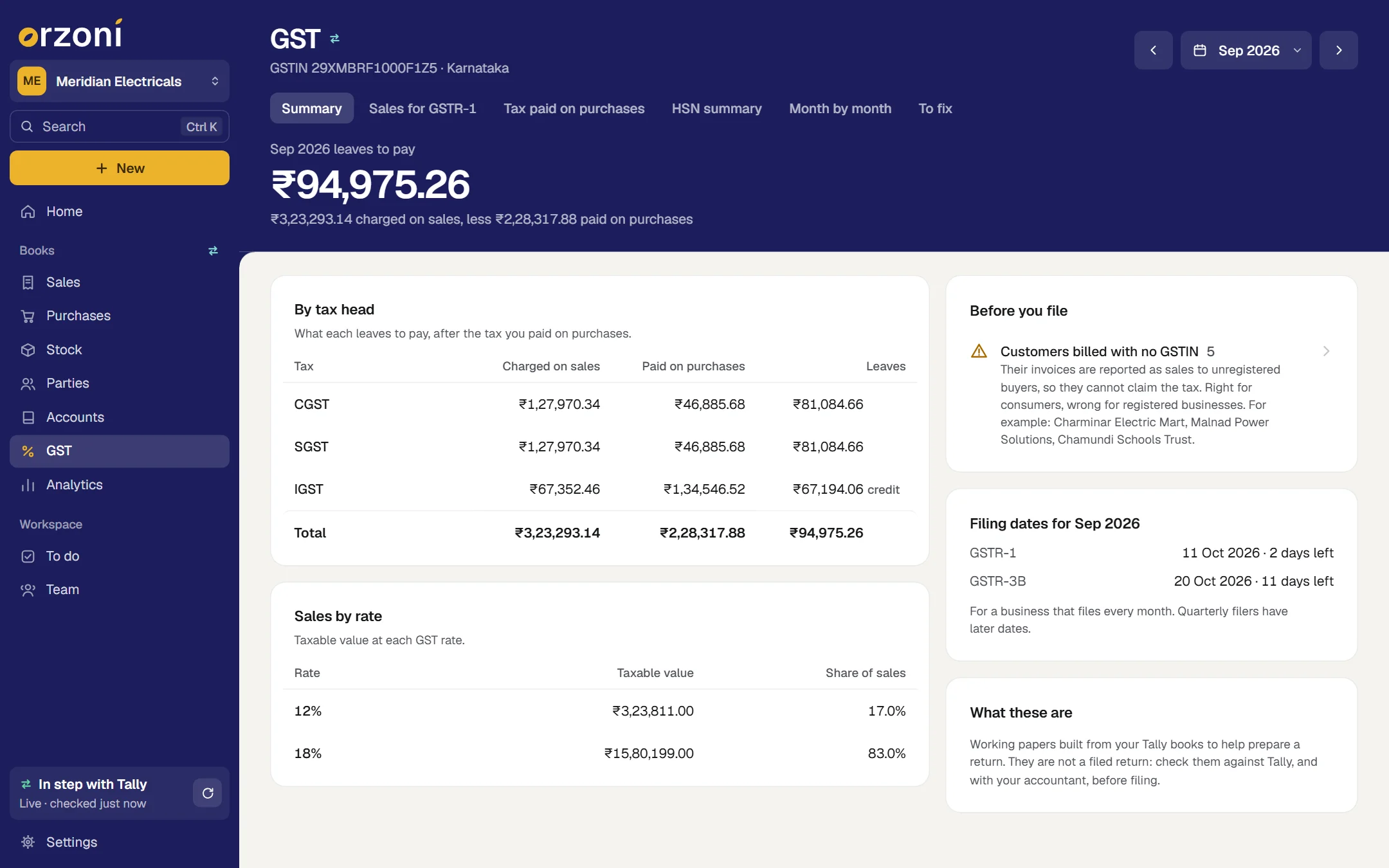
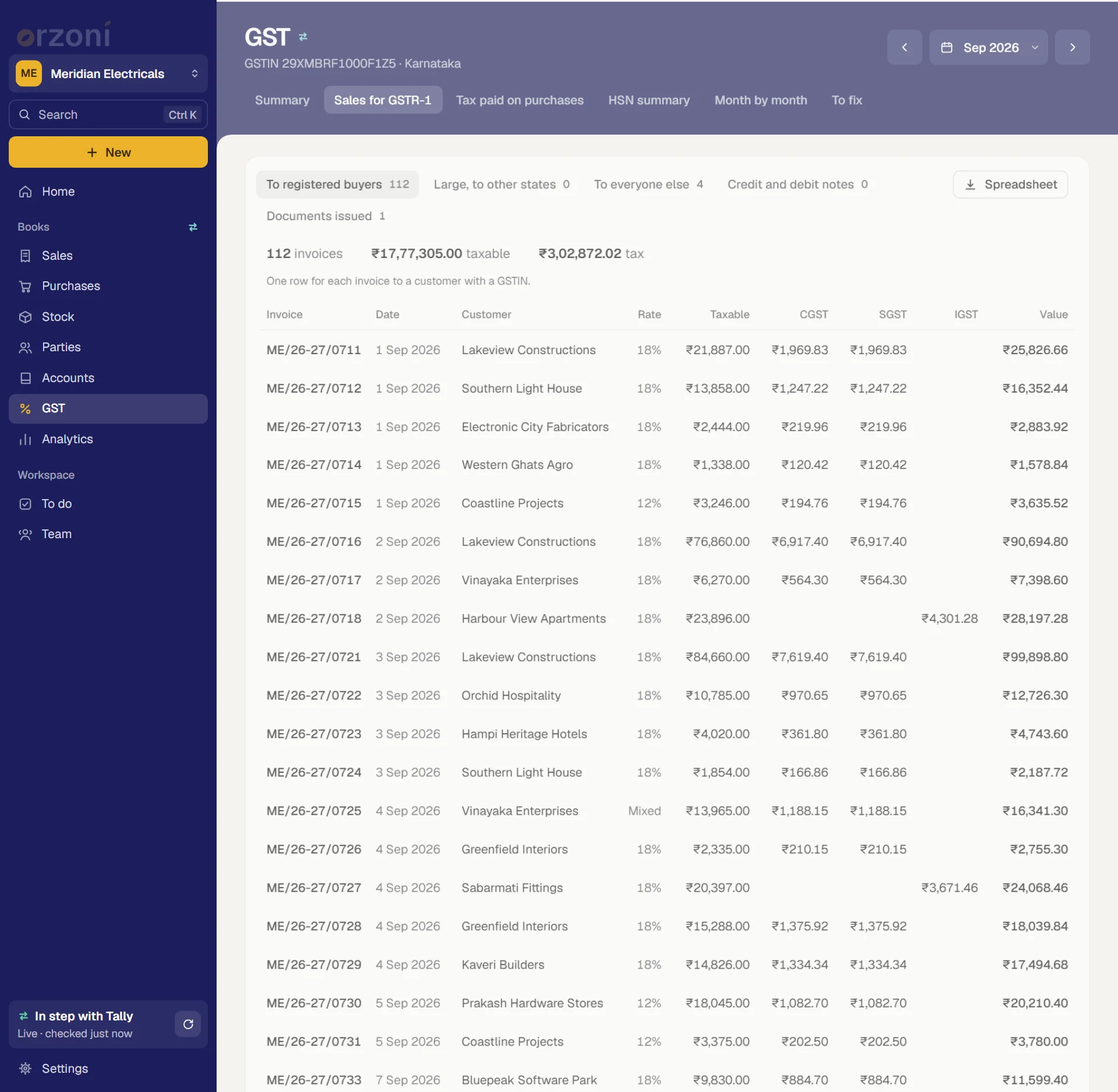
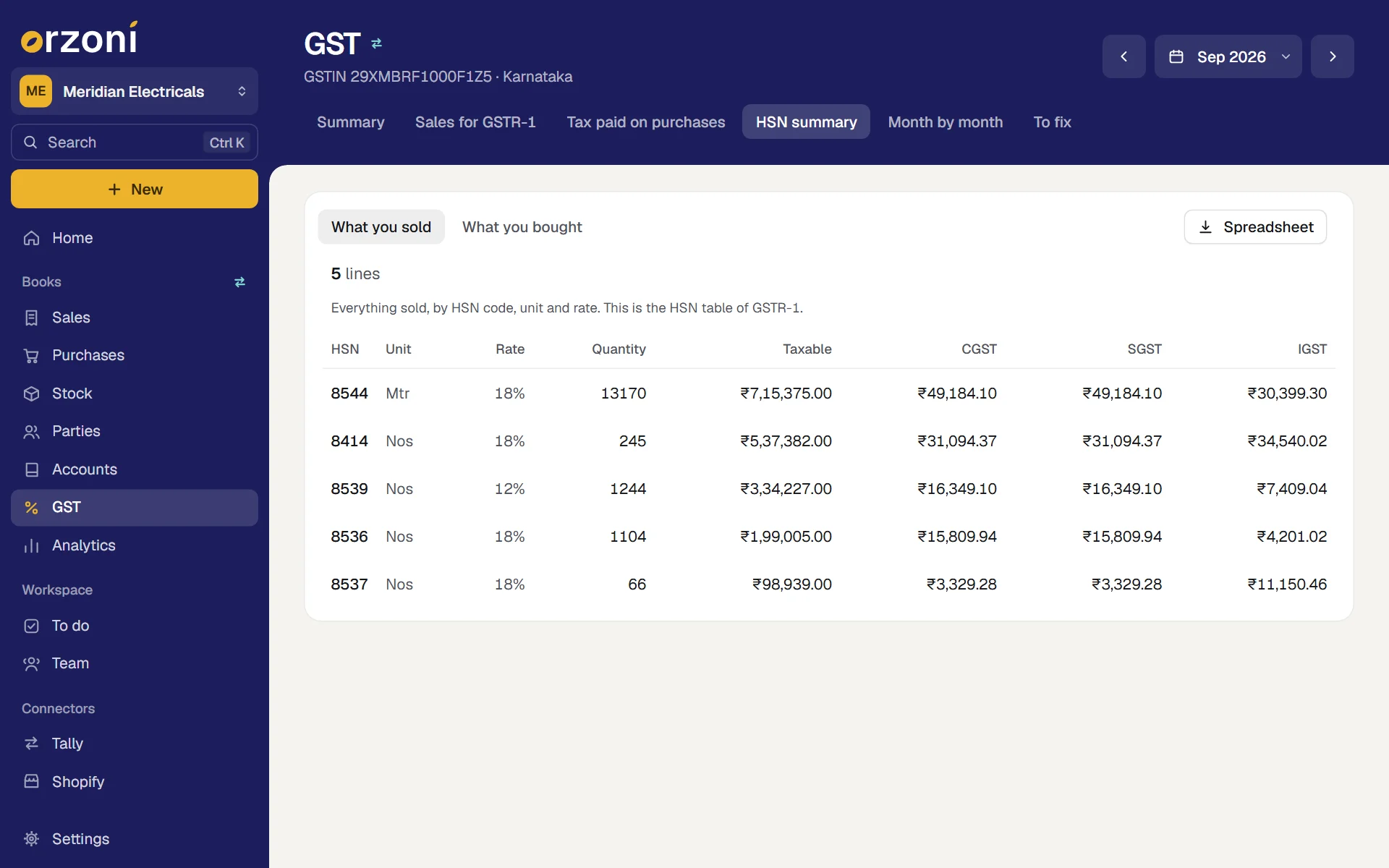
- The papers for the return are laid out. Sales for GSTR-1 by table, tax paid on purchases, the HSN summary, each month side by side, and a count of documents issued with the numbers no document carries.
Know where it stops. These screens are working papers for you and your accountant. Orzoni is not a filing tool: it does not file returns or produce the file the GST portal takes. It makes no e-invoices and no e-way bills: a business over the ₹5 crore limit, or one sending out a consignment worth over ₹50,000, makes those in Tally as it does today. Export bills, and bills for a company registered in more than one state, are made in Tally too. The guides say so plainly: see GST, Make a sales invoice, Invoices, bills and the Day book and What Orzoni leaves to Tally, and what is coming.
If your bills begin as online orders, From a Shopify order to a GST invoice in one press follows one order through the same rules.
Questions people ask
Does a GST invoice have to follow a fixed format?
No layout is prescribed for an ordinary tax invoice. Rule 46 lists what it must contain. Any layout that carries those particulars will do, which is why two correct bills from two software packages look different. An e-invoice is the exception: it follows the form the rules name.
Can I run more than one invoice series?
Yes. Clause (b) allows "one or multiple series". Each series must be consecutive in itself, and every number must be unique in the financial year, so give each series its own prefix.
Does a composition dealer issue a tax invoice?
No. A person paying tax under the composition scheme issues a bill of supply under Section 31(3)(c) and Rule 49, which shows no tax. Their buyers get no input credit from it.
The customer wants one line changed on a bill from last month. What do I do?
Issue a credit note or a debit note against the invoice, under Section 34, and report it in the month you issue it. Do not edit the old bill and send it again under the same number: the original is already in your return and may be in the buyer's.
Is a bill without HSN codes invalid?
For a business that must print them, a bill without them does not carry all the particulars the rule asks for. Rule 36(2) may still allow the buyer's credit if the essentials are there, but that is the buyer's risk to take, and many will send the bill back instead.
Make one bill and check it against the list
Take the last invoice you issued and hold it against the fourteen marks on the picture. If a field is missing, fix it where it comes from: the customer's GSTIN, the item's HSN code and rate, the numbering. Then the next hundred bills are right.
Orzoni prints a tax invoice in Tally's layout with the particulars in place, works out the tax from the customer's state, and puts the bill into your Tally books. Nothing is charged today: see Pricing, then make one bill and check it.
Facts and sources
Every rule in this post was read on the source below on 11 October 2026. The CBIC pages are the official text of the Acts and Rules with amendments marked.
| What | Source | Read on |
|---|---|---|
| Particulars of a tax invoice, serial number, ₹50,000 and close-of-day provisos, signature proviso | Rule 46, CGST Rules: taxinformation.cbic.gov.in, rule 46 | 11 Oct 2026 |
| Thirty days for services, forty-five for banks, insurers and NBFCs | Rule 47: taxinformation.cbic.gov.in, rule 47 | 11 Oct 2026 |
| Triplicate and duplicate copies, serial numbers in GSTR-1, e-invoice power, "shall not be treated as an invoice" | Rule 48: taxinformation.cbic.gov.in, rule 48 | 11 Oct 2026 |
| Bill of supply; credit and debit note particulars; delivery challan | Rules 49, 53 and 55, same repository, chapter 6 | 11 Oct 2026 |
| Time of issue for goods, under ₹200, bill of supply, receipt voucher, continuous supply, sale on approval | Section 31, CGST Act: taxinformation.cbic.gov.in, section 31 | 11 Oct 2026 |
| Conditions for input tax credit; documents and minimum particulars | Section 16, CGST Act, and Rule 36: taxinformation.cbic.gov.in, section 16 and rule 36 | 11 Oct 2026 |
| Discount recorded in the invoice; packing and incidental expenses in the value | Section 15, CGST Act: taxinformation.cbic.gov.in, section 15 | 11 Oct 2026 |
| Inter-State and intra-State supply; place of supply of goods | Sections 7, 8 and 10, IGST Act: taxinformation.cbic.gov.in, IGST section 10 | 11 Oct 2026 |
| E-way bill before movement of a consignment over ₹50,000, value including tax | Rule 138: taxinformation.cbic.gov.in, rule 138 | 11 Oct 2026 |
| HSN digits: 4 up to ₹5 crore, 6 above, optional for unregistered buyers up to ₹5 crore, from 1 April 2021 | Notification 78/2020-Central Tax, 15 October 2020: gstcouncil.gov.in | 11 Oct 2026 |
| GSTR-1 Table 12 third phase and Table 13 mandatory from the May 2025 return period | GST Network advisory of 1 May 2025, as carried by the Maharashtra GST department: mahagst.gov.in; the dropdown and the B2B and B2C split as reported by Taxmann | 11 Oct 2026 |
| E-invoicing above ₹5 crore from 1 August 2023, for supplies to registered persons | Notification 10/2023-Central Tax, 10 May 2023, amending Notification 13/2020-Central Tax; summarised by EY and Taxmann | 11 Oct 2026 |
| 30-day limit for reporting e-invoices: ₹10 crore and above from 1 April 2025, earlier ₹100 crore and above | GST Network advisory of 5 November 2024, as carried by the Maharashtra GST department: mahagst.gov.in | 11 Oct 2026 |
| Penalties: ₹10,000 or the tax evaded, whichever is higher; up to ₹25,000 | Section 122(1)(i) and 122(3)(e), CGST Act: taxinformation.cbic.gov.in, section 122 | 11 Oct 2026 |
| Credit and debit notes; the 30 November limit | Section 34, CGST Act: taxinformation.cbic.gov.in, section 34 | 11 Oct 2026 |
| Records kept for seventy-two months | Section 36, CGST Act: taxinformation.cbic.gov.in, section 36 | 11 Oct 2026 |
| What Orzoni does and does not do with GST | Orzoni's guides: GST, What Orzoni leaves to Tally, and what is coming | 11 Oct 2026 |
Left out on purpose: GST rates for particular goods (they are set by rate notifications that change, and yours should be looked up, not copied from an example), State-specific e-way bill limits, and anything on exports and special economic zones beyond a mention.

Guides this post leans on
The GST screen works one return month at a time. What the month leaves to pay, the sales tables for GSTR-1, tax paid on purchases, the HSN summary, every month side by side, and the details to fix before filing. Working papers, not a filed return.
Read the guide Make a sales invoiceCustomer first, then items, GST worked out for you, paid now or later, and Send to Tally. With Create from the bill itself, cash sales, proformas, drafts, Tally's keys, and what to do when a bill cannot be made.
Read the guide Invoices, bills and the Day bookThe lists under Sales, Purchases and Accounts. Their views and search, how a row says whether a bill is paid, and what you can do from one entry: record a payment, print, save a PDF or send it on WhatsApp.
Read the guide What Orzoni leaves to Tally, and what is comingWhat Orzoni needs, what is made in Tally rather than here, how some figures are worked out, and what is coming next.
Read the guide